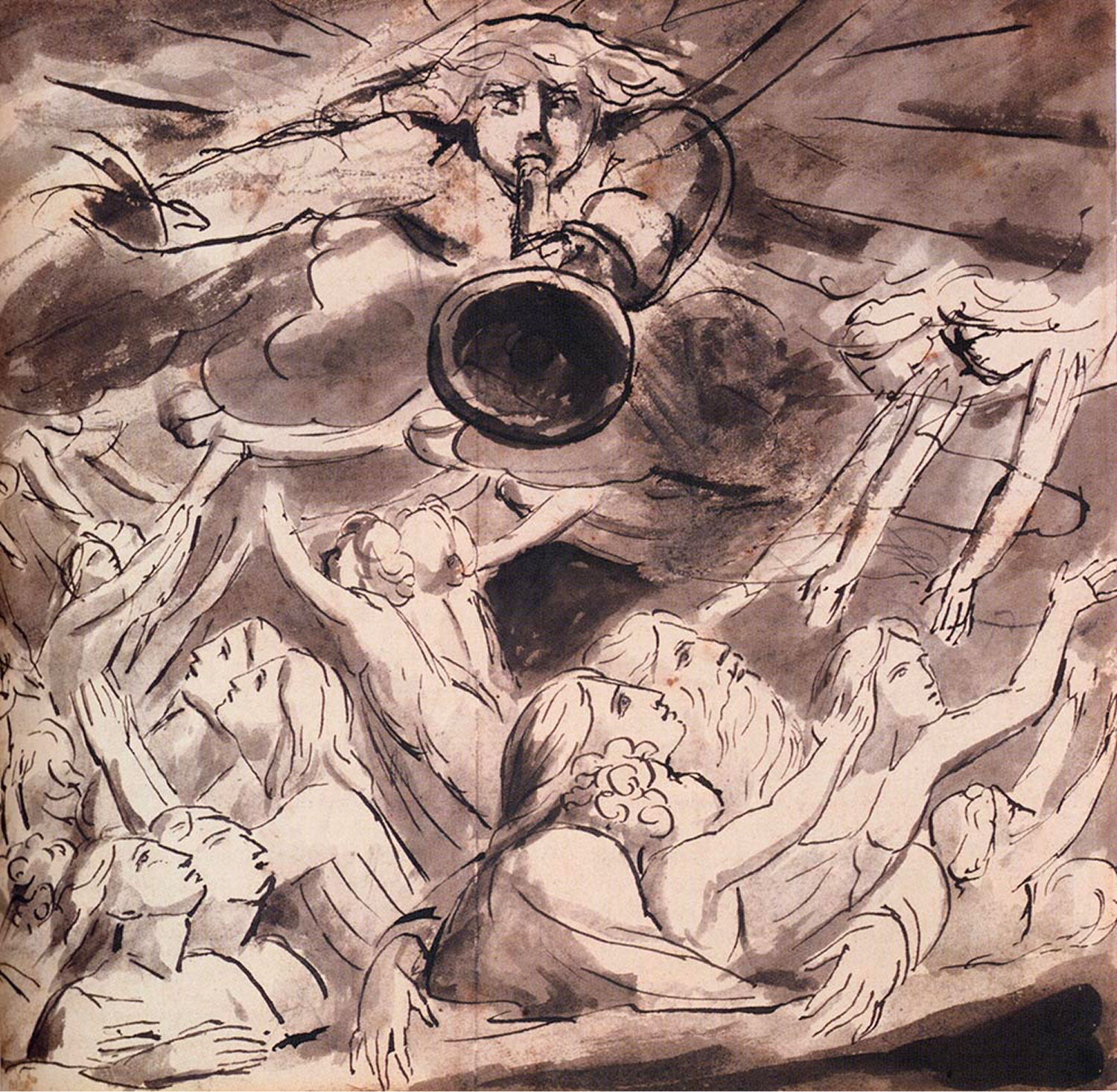
In The Beginning


A Rumination on an Easter Day

“O seeker after the divine mysteries! Know thou that the door to the knowledge of God will be opened to a man first of all, when he knows his own soul, and understands the truth about his own spirit, according as it has been revealed, ‘he who knows himself knows his Lord also.’” —Al Ghazzali, The Alchemy of Happiness

“God is God only so far as he knows himself. Further, God’s self-knowledge is a self-consciousness in man and man’s knowledge of God, which then proceeds to man’s self-knowledge in God.”— Georg Hegel, Encyclopedia of the Philosophical Sciences

I. The Beginning


In the beginning was the Rebirth, and the Christ reborn was with God, and the Christ was God.

On Easter Christians celebrates the Resurrection or Rebirth of Jesus Christ. The concept of Rebirth corresponds, on the one hand, to the concept of Moksha in Hinduism or Nirvana in Buddhism, but on the other hand, presents a unique possibility of a life beyond Moksha or Nirvana which is generally seen as the culminating end point of spiritual awakening and transformation.

Through the Rebirth, Jesus is born as Christ, that is, Jehovah incarnates as Christ, and then Jesus Christ ascends further in evolution. The Rebirth is not only the culmination of spiritual transformation but also the new beginning of further spiritual evolution. One phase of spiritual development is complete at the crucifixion and the new phase begins with the Resurrection.

Jesus Christ is a paragon and a paradigm, but throughout history there have been many illumined men and women who experienced a spiritual rebirth and ascension. For them in the beginning was a Rebirth. But for the great majority of humanity that beginning is as yet unbegun.

However, as articulated below, spiritual rebirth is our human destiny and our divine promise. Jesus Christ is an exemplar, just as Krishna or Buddha is, and shows the way (“I am the way, the truth, and the life.” John 14:6), but the work of self-evolution toward rebirth we must each do for ourselves.

Though Christ a thousand times in Bethlehem be born,
But not within thyself, thy soul will be forlorn:
The cross of Golgotha thou lookest to in vain,
Unless within thyself it be set up again.

— Angelus Silesius (Johannes Scheffler)

II. The Beginning As Yet Unbegun

In the beginning was Intelligence. Intelligence was with Love. Intelligence was Love.


The Light of Intelligence enwrapped in the form of the human mind, in its evolutionary ascent, became vainly proud of its intellectual power and fell into arrogance, arrogating itself solely, in its delusionary grandeur, to the throne of omniscience and omnipotence by separating itself from Love, and by making its truth the supreme truth, disregarding Good, the ultimate purpose and meaning of attaining Truth.

This is the Luciferian tragedy of the “Fall” of Mankind. Lucifer, the Light of Intelligence or the Mind, in his pride, conceit, and arrogance, disobeys God, that is, rejects the Word of the Wholeness Divine, and commits an act of theft, stealing the throne of power from his Divine Source, not in reality but in his delusional imagination, and separates himself from his wiser twin, Christ, the Light of Love or the Heart.

Lucifer, the “Light-Bringer”, in his willful separation from Christ and diremption from God, self-transmogrifies to become Satan—that is, Noctifer, the “Night-Bringer”. Satan represents the Intelligence without Love, the Mind without Heart, the Reason without Intuition, and the Intellection without Inspiration, who claims, in Milton’s Paradise Lost:

To reign is worth ambition though in Hell:
Better to reign in Hell, than serve in Heav’n.


Mind is the defining characteristic of Man (humanity). Man is of the Mind in the most essential sense. And the human mind is so blessed and so well-developed that now it knows, theoretically, the Mind of God, and yet it is so removed afar from the Heart of God that its knowledge lacks true understanding, for it is neither aflamed with Love nor alight with Good.

That which the human mind knows at the apex of its intellectual attainment, the Mind of God, it understands not. Knowledge per se is not understanding as such, for knowledge is of outer distinctions, whereas understanding, “stand under”, is of inner substance—that which “stands (stance) under (sub-)”. Therefore, that is not complete knowledge which is without understanding. Knowledge becomes complete only when it is substantiated by understanding.

Whereas knowledge proper is only within the domain of epistemology, understanding spans both epistemology and ontology. Understanding is substantiation in the sense of increasingly providing substance to your own being. Understanding substantiates and ultimately transubstantiates when the state of your being and awareness radically and fundamentally, that is, substantially, transmutes to a categorically higher state.

This understanding which provides substance for our being or soul is what is meant by the word “bread” in the Lord’s Prayer:

“. . . Give us this day our sustaining bread . . .” — translation from the Eastern Greek Orthodox Bible (EOB).

The “bread” signifies “spiritual nourishment”, while the original Greek word, epiousios, translated as “sustaining” in the above translation, which is usually mistranslated as “daily” in almost all English translations, means “upon” or “over” (epi-) “that which is one’s own” or “substance” (ousios).

“Give us this day our spiritual nourishment upon our own substance.” This spiritual nourishment (“bread”) is understanding or that which is provided or supplied by the understanding. Therefore, the sentence implies, “Help us this day develop further the understanding that spiritually nourishes our own substance (soul, being, or self).”

There is a saying, “Man is his deed,” but deed arises and proceeds from understanding; therefore “Man is his understanding,” which is to say, “Man is his substance.” Human beings are each his or her individual substance, which consists of the totality of his or her understanding of the self, the humans, the world, the universe, and “God” (what the individual considers to be the Supremest which provides meaning to existence).

That the understanding comes from the union of Intelligence and Love, of Mind and Heart, of Reason and Intuition, or of Lucifer and Christ, and that the understanding spans the domains of both epistemology and ontology, means that the understanding involves our whole being including our feeling. When we understand, not only do we know but do we also feel the whole substance of what we know.

This is one of the primary reasons that machine “intelligence” or AI can never replace human intelligence. AI may simulate understanding, that is, it can pretend as though it understands, but it does not nor can it ever in reality understand anything. Therefore, those who only know but do not understand are similar to AI and yet inferior in their mental capacities wherein AI far excels humans.

Therefore, to re-begin the beginning, that is, to re-unite Intelligence with Love, Mind with Heart, Intellection with Intuition, and Lucifer with Christ means to re-claim our humanity and to re-explore the human intelligence in its entire spectrum which is holistic, inclusive of Intuition and Imagination, and Understanding and Innerstanding (spiritual understanding), beyond computation and logical reason or intellection.

To re-begin the beginning as yet unbegun is to return to the beginning that began in the beginning. And it is only we each individually who can return and rebegin. 


In the beginning was Truth, and Truth was with Good, and Truth was Good.

In the name of “the” truth and for the sake of defending or promoting it, countless wars have been fought and countless lives have been lost, mercilessly sacrificed for the cause of “the truth”, while many brilliant freethinkers who dared to think for themselves have been persecuted and killed as heretics—for example, Marguerite Porete (1310), Michael Servetus (1553), and Giordano Bruno (1600).
Also, it was two different versions of “the truth” concerning the concept of the Holy Trinity that brought about the separation of the Eastern Orthodoxy from the Western Christianity (the filioque controversy). The word “Godhead (Godhād in Old English)”, which originally meant “Godhood”, began to represent the Holy Trinity (Godhead = God & Christ & Holy Spirit), which became, literally, an extremely “heady” (willfully mental and hyper-intellectualized) theological issue for never-ending and unsettled contentions lasting over 17 centuries.

The Christian scholars, priests, theologians, and philosophers have turned Godhead into the “heady” (hyper-intellectual) matter, reflecting and projecting their own over-intellectualized heads, forgetting to embody the Heart of God, “Godheart” that is Good, notwithstanding their lip service to God’s Love.

The same has happened with the priests and scholars of all religions. The intellectuals of today are the same. The only difference are the specific issues of their contentions and argumentations. They all exemplify the “Luciferian Fall” in their tendency for over-intellectualization upon various philosophical, theological, or metaphysical issues in the absence of true understanding.

The Word of Truth that was and is always “in the beginning” is the supra-sensible and supra-mental spiritual Truth for which there is or can be no proof based on the evidence of the senses nor according to the reason and logic of the sense-bound mind. This Truth abides and is known only in the “Heaven”—the suprasensible and supramental internal spiritual world which categorically differs from and transcends the sense-perceptible external world, symbolically called the “Earth”.

Spiritual truth is akin to mathematical axioms and theorems that have noumenal ontological referents and correspondents but no sensory perceptible phenomenal referents or correspondents.

That which is called “Faith” is the sense of certitude that you have of spiritual truth. Faith is based on the knowledge of the truths of the supra-sensible and super-mental (or higher mental) spiritual realm of Reality. Faith thus requires a higher level and quality of intelligence, which is coexistent with a higher and finer state of consciousness, than the intelligence that is bound and limited by sensorial perceptions..

Faith is that which transmutes fear into courage. Faith is a reading of reality using the subtlest, inmost faculties of the heart-mind which is connected to the supramental and blessed with the spiritual. Faith is a link to the irresistible cosmic forces of the universe that work to support us in the fulfillment of our purpose.


The certitude that is with faith is the power which calls the principle of creativity into action, and which enables you to relate yourself in the Eternal Now to a new self, new life, and new reality as yet unseen, and to sever your relation with the old self, old life, and old reality bound to the sensorial world.

When you have faith, Truth is with Good, Truth is Good. Thus, in order to rebegin, having Faith becomes essential.

In the beginning was Meaning, and Meaning was with God, and Meaning was God.

When the Light of Intelligence becomes aflamed with the Light of Love, we come to understand the Heart of God beyond knowing the Mind of God. The knowledge of Truth then becomes secondary to the Will to be and to do Good that arises from the benevolent fountainhead of love and compassion.

Understanding the Heart of God is the Understanding in its supremest expression and manifestation. It is the highest Wisdom. Then, philosophy, the love of wisdom, fulfills its vocation and destiny and becomes the Wisdom of Love, which is Theosophy in its true meaning—that is, Divine Wisdom. The Truth that is Theosophy or Divine Wisdom is the Metacosmic Matrix of Meaning because of which everything in the universe obtains the meaning for its existence.

When we begin to understand the Meaning of the spiritual Truth, when we thus begin to grow in our Faith, God, Reality, or Universe begins to reveal itself to be the Matrix of Meaning wherein we will be born again to live a life anew in the same manner in which creation begins in time.

III. Before the Beginning


At the beginning of Time Meaning already was, and God had Meaning with Him, and God was Meaning.

God is Meaning. Meaning is God. If you think or feel that there is Meaning in existence, it is a tacit self-confession that you believe in God. And Meaning was before time began and is always before time begins. Meaning was and always is before creation that takes place in time. Meaning transcends the dimensionality of time and therefore it is always before the beginning of creation in time.

The beginning that is recognizable as a beginning is not the true beginning. For, when a beginning becomes recognized as the beginning, the true beginning had already begun.

That is before the beginning, which is the true beginning, does not belong to time but to Eternity—the Eternal Reality that is the Matrix of Meaning. The true beginning is not of the temporal order but of the ontological order—not in the order of temporal or chronological Becoming but of atemporal or eternal Being. Thus, the “before” in “before the (temporal) beginning” signifies the true beginning’s ontological priority or primacy that it is ontologically before or prior to the beginning of time—that it originates time and its chronological beginning.

Therefore, what was in the beginning, is always in the beginning, and will be forever in the beginning. The Genesis states, “In the beginning God created the heavens and the earth.” Thus, God (Meaning) was before the beginning, and God always is and forever will be before the beginning. God was what God was. God is what God is. God will be what God will be.

Before the beginning, before there is existence, God subsists. The threshold wherein Eternity produces time and creation begins—the threshold that is the beginning of “in the beginning”—is the beginning of existence in time, and that which comes to exist is the universe. God unmanifest begets God manifest that is the universe which is the “only or uniquely (unicus = one) begotten son” of God.

What is often missing in the depiction of the beginning and of God and Divinity is the presence of the elementary feminine (yin) aspect that was and that is always present in Reality. God, the Grand Operative Dynamic of the Universe, is at once One and Twain.

God is the Father and the Mother—Twain in One. The Father is the active principle (yang), while the Mother is the passive principle (yin). The Mother (Mater) is the Matter (substance) into which the Father (Pater) in-forms (impregnates) the myriad Patterns of his Thoughts. The Mother is the Matrix in which the seeds of the Father’s thoughts are conceived, nourished, and grown.
In the beginning there is always oneness that is twoness. To understand the beginning, we need to understand the syndiffeonesis (difference-in-identity/identity-in-difference) of one and twain, of unity and duality, which extends to the syndiffeonesis of one and many, of unity and multiplicity, of simplex and multiplex.

Man (humanity), the image and likeness of God, also was, is, and will be before the beginning ontologically, and Man begins as God begins. And it is always Now, the Now Eternal, where God and Man begin.

That which was before the beginning—the primordial union of Intelligence and Love, of Mind and Heart, of Lucifer and Christ—of the Father and the Mother—must rebegin as Meaning received and conceived in the Matrix of Meaning. And before the rebeginning, we have within ourselves what it takes to rebegin—Freewill.

“To be free means that I myself will make myself whatever I am to be. I must already be that which I shall become; in order to be able to become so, I must possess a twofold being, of which the first shall contain the fundamental determining principle of the second.” — Johann Gottlieb Fichte, The Vocation of Man (1800)

“Heed not the teachers who tell thee to deny and crucify thyself. Thou art thy own law, thy own Bible, thy own model. There are no Scriptures so sacred as those written in thy soul; read them carefully, and obey them faithfully, ever seeking for new light to scan aright their pages, from the world around thee, transcribed in books, or engraven upon the ever-living page of Nature herself. So shalt thou develop into a noble, sound, whole-souled being, happy in thyself, and diffusing happiness, as the rose its fragrance, to all around.”— William Denton, Be Thyself (1872)

IV. In the Beginning


Divinity is the Substance of Reality. The ancient seers called Reality what is designated as “God” in English or its various equivalents in all different languages. For, once we wholly understand Reality, its Holiness becomes unmistakable and we become filled with reverence for the awe-inspiring Sacredness present in and as Reality.

Divinity is also variously conceived and called: Divinity is the essential nature of God which he shares with all of his creations in the Universe—his “only (uni/one) begotten Son”; Divinity is the Holy Spirit that is God’s eternal Spiration which is consubstantial with God; Divinity is the Metacosmic Intelligence that Thinks and whose Thought is the eternally regenerative Universe; Divinity is the Language, the Word, the Logos that is the Substance of Reality which generatively self-simulates through infinite tautological variations in the act of self-configuration and self-processing.

In the beginning God created the heavens and the earth.

Humanity is the creative destiny of Divinity. Divinity is the evolutionary destiny of Humanity. Heaven is God’s eternal abode and hence it is uncreated. The heaven that God creates in the beginning for every human being is the individual’s evolutionary possibility and ultimate destiny.

We human beings are each born onto the earth as a possibility with a potential to be reborn into the heaven. The earth designates the exterior world of sensorial perception, while the heaven designates the interior world of spiritual understanding and wisdom. The earth symbolizes corporeality, while the heaven symbolizes incorporeality.

There is the ontological inverse law that states: Substantiality is inversely proportional to corporeality. This is counter-intuitive or even nonsensical from the sense-perception based viewpoint, but it is absolutely true in the spiritual world, the heaven, according to spiritual perception. What is less substantial from the perspective of the earth is more substantial from the perspective of the heaven.

The thinking that originates in and from the heaven based on the spiritual perception fundamentally differs from the thinking that originates in and from the earth based on the sensual perception. The knowledge of the heaven relates to cause and causality and the thought therein and therefrom is deductive in essence (being akin to mathematics), whereas the knowledge of the earth relates to effect and effectuality and the thought therein and therefrom is inductive in essence (being akin to physics).

In the beginning there is a distinction, division, diremption, created between the heaven and the earth, and the seven days or stages of genesis signifies the evolutionary process of unification, or rather reunification, of the heaven and the earth into one whole reality. We humans are unique among all of the creatures of the earth. We alone are birthed on the earth with the possibility of a re-birth in the heaven, and therefore the possibility of reunification.

Corporeality is the world of corpus or corpse whose temporary life comes from a source that is external to it, while incorporeality is the world of Spirit that is the eternal source of life. This Spirit is the Principle of Life Eternal that inspires (breathes in) a temporary life into a corpus that is conceived through a copulation and born out of a corporeal womb, and then exists for a while in the corporeal world until its life expires (breathes out the last breath).

The birth into the heaven is your rebirth from the matrix of corporeality into the matrix of incorporeality not through a physical copulation of two corpuses that are not you but through your own conscious act of a metaphysical union with the Spirit. This union is called Theosis. The possibility as which you were born into this corporeal world is the possibility of attaining a theosis, of being re-born as a new Self in union with the Spirit, and of consciously merging with the Life Eternal.

“God is an infinite sphere, the center of which is everywhere, the circumference nowhere.” — attributed to Hermes Trismegistus, from The Book of the Twenty-four Philosophers

This is a geometrical metaphor of the vision of the omnicentric universe which I had when I was almost 16, but the same idea has been expressed by great many thinkers and seers throughout history. Every center, every central point, of this omnicentric universe has an interiority, an interior world, that reflexively contains the infinite whole to which it is also a transdimensional portal. Therefore, the universe is singularly one and infinitely many at the same time.

The heaven is the designation of that interiority of every human being, while the earth the exteriority. Our access to the heaven is our spiritual (supersensible) perception and higher mental (supramental) conception developed therefrom, while our access to the earth is our sensorial perception and lower mental conception (based on “the evidence of the senses”) developed therefrom.

The ultimate purpose of human life is to achieve “Theosis”—Union with God—and to enter and evolve in the heaven, the eternal abode of God. Theosis is another name for spiritual Rebirth in which Christ is at one with God. The ultimate meaning of human life is to express and manifest the heavenly on the earth.

Seen in and from the heaven, the earth, God’s creation, is an integral part of the heaven and is perfect and to be blessed, even as a masterpiece at each stage of its development is good and perfect, even though it does not have the ultimate degree and culminating height of grace and beauty it will have when complete. The evolution of humanity at large is unfinished and incomplete but every man or woman is good and perfect at his or her present stage of evolution. The evolution of the world at large is unfinished and incomplete but every event taking place in the world is good and perfect at its current stage of evolution.

Humanity is a God’s masterpiece in the making. We, individually and collectively, can be a human masterpiece—the image and the likeness of God—as exemplified by Jesus Christ and other illumined human beings. What is required is an authentic alignment and attunement with the Principle (Logos) of Evolution at work as the current of Life that permeates the universe and fills your being. With the spiritual rebirth, you enter the final stage of evolution toward becoming a completed human masterpiece.

Easter is the day of celebrating Jesus Christ’s rebirth. It is also the day of remembering our own possibility and responsibility for our own spiritual rebirth. Responsibility is the ability to promise (spond) anew (re-). Spiritual rebirth is the promise that we make with our own Self who is our Maker—God within, eternally existing as our innermost and supremest I AM. Jesus Christ is an idealized archetypal exemplar; he is a paragon and a paradigm; and his biography is our own psychography of self-transformation.

Easter follows Lent, a 40-day period of metanoia. Metanoia is translated as “repentance” in almost all English translations, but it etymologically means “ to change one’s mind” and does not carry the sense of “feeling regret for sins, transgressions, or crimes” or of “being grieved over one’s past and seek forgiveness”. Repentance or regret may lead to metanoia, a radical change of mind, but metanoia does not require repentance or regret.

Metanoia means coming to have a new mind with new thoughts, which requires having a new kind and level of knowledge. In the context of Lent and Easter, Lent begins when you have a realization of a spiritual truth, which is a remembrance or recollection of an eternal truth which you have, and humanity as a whole has, long forgotten. Then you begin the journey of your spiritual development towards your spiritual rebirth which is the completion of this phase of your spiritual evolution that is possible while living on the earth in the human form.

Yet, you must not forget that there is a crucifixion, a death, before the rebirth. There is an ending before a new beginning. Will the death be painful? No. The pain can occur only before the death as the result of the resistance to dying. Hence, no resistance, no pain. The death itself, the crucifixion itself, is an ecstatic experience as you stand (static) outside (ec-) of your body and the world of senses, from which you are liberated.

In the beginning was the Word, and the Word was with God, and the Word was God.

The ”Word” in the original Greek is the Logos, while the Hebrew word for “Word” is Dabar. In ancient Hebrew, a word was not just a sign for an idea existing apart from action. Every word had an accompanying action. To speak, to utter a word, was to act. Thus, when God spoke in Genesis I, His speaking was an act of creation. His Word was the creation of the universe.

When God speaks he means what he says. When Christ speaks he means what he says. When Buddha speaks he means what he says. The Word that they speak not only has a meaning but also is the Meaning itself. This is why their utterance is at once the action.

When you speak, do you mean what you say? You mean what you say and you say what you mean—this is Samyak-vac, meaningful (“right”) speech, the third precept of Buddha’s Eightfold Path. Samyak-vac is the fully integrated honesty expressed in your speech act and communication. You must be completely free of any kind of vanity and any form of pretension to mean what you say and to say what you mean. You must be yourself and must know and understand yourself to be able to say what is worth saying and therefore to mean what you say.

In the beginning is the Word. It is always the Word that alone is in the beginning. You begin by authentically saying “I begin” and honestly meaning what you say. To begin your journey of rebirth, you must mean what you say that now you begin your journey of rebirth. In the beginning is Meaning, and Meaning is with God, and Meaning is God.
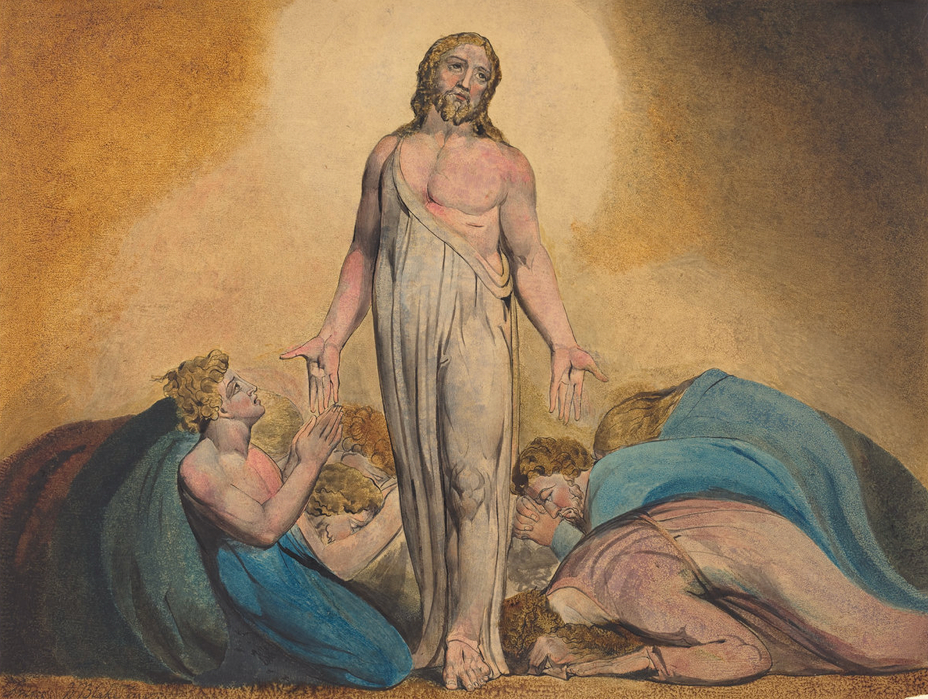
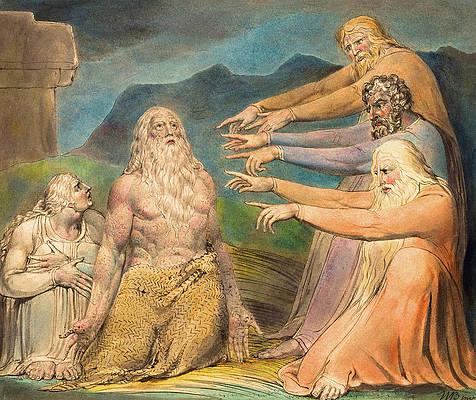
“Christ Appearing To His Disciples After The Resurrection” by William Blake

Never the spirit was born; the spirit shall cease to be never;
Never was time it was not; end and beginning are dreams!
Birthless, and deathless, and changeless remaineth the spirit forever;
Death hath not touched it at all, dead though the house of it seems.


—Sir Edwin Arnold, The Song Celestial (The Bhagavad Gita)

Yasuhiko Genku Kimura. Copyrights © 2025. All Rights Reserved.
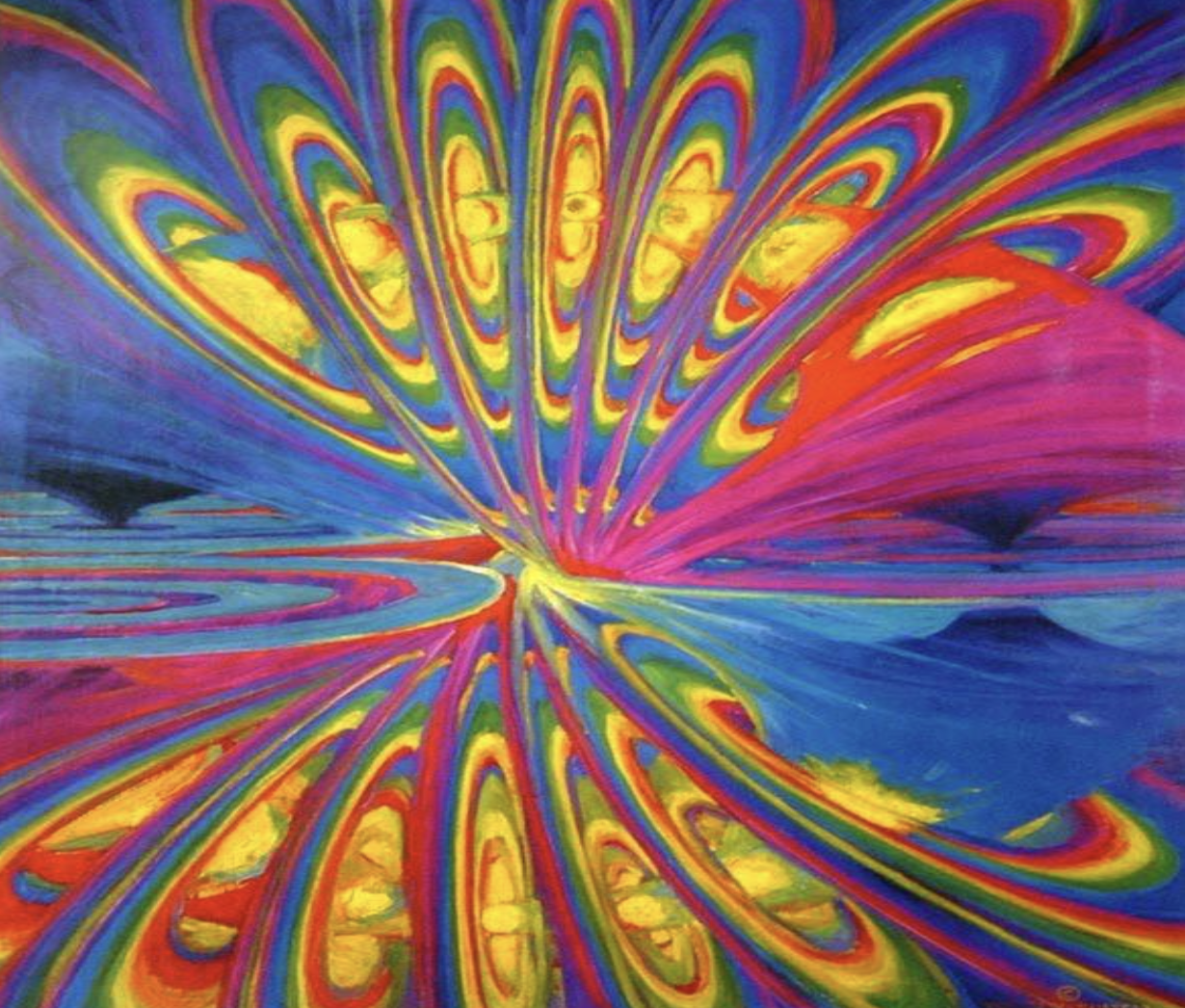
Eternity and the Octave Wave

Yasuhiko Genku Kimura

Eternity is the supramental Absolute Now Movement of Consciousness, categorically different from the relative mental and phenomenal motion which is divisible and measurable in terms of linear or circular time.

Transformation of Consciousness—Spiritual Awakening—takes place in Eternity as the absolute movement of the Eternal. It is the moment of Awareness as the momentum of Eternity when and where the Self ceases to identify itself with all that is temporal, with all that is of the mind, in its luminous atemporal Self-Awareness. (YGK, July 20, 2010)


The painting “The Octave Wave” by Walter Russell depicts the image of the Cosmic Mind’s (Absolute Spirit’s) Imagining of Creation and Evolution seen in and by Cosmic Consciousness.

This is a visual image of the ancient Indic-Brahmanic ontogony-cosmogony. Brahman, Absolute Spirit, or World One (Sun Absolute) initially emanates-creates as World Three or Sat-Cit-Ananda: Cosmic Being-Cosmic Consciousness-Energy/Delight (“Energy is Delight” – William Blake).

Sat (Cosmic Being) is at once Nothing and Cit (Cosmic Consciousness) is Space of Light, while Ananda (Energy/Delight) is expressed in color and form as a dynamic cyclic octaval pattern of two-way movement which is the onto-cosmological Becoming of emanation-creation and returning-evolution.

The Cosmic Creation-Evolution is Brahman’s or Godhead’s two-phase Imagining — Dreaming and Awakening. Since it is the act of the Divine Imagination, the human imagination can capture it artistically as well as scientifically.

In “The Octave Wave” the Art and the Science of Walter Russell’s Cosmogony unite.


Beauty Will Save the World

Yasuhiko Genku Kimura

In his Nobel lecture, Aleksandr I. Solzhenitsyn’s made the following remark:

One day Dostoevsky threw out the enigmatic remark: “Beauty will save the world”.

What sort of a statement is that? For a long time I considered it mere words. How could that be possible? When in bloodthirsty history did beauty ever save anyone from anything? Ennobled, uplifted, yes, but whom has it saved?

There is, however, a certain peculiarity in the essence of beauty, a peculiarity in the status of art: namely, the convincingness of a true work of art is completely irrefutable and it forces even an opposing heart to surrender.

It is possible to compose an outwardly smooth and elegant political speech, a headstrong article, a social program, or a philosophical system on the basis of both a mistake and a lie. What is hidden, what is distorted, will not immediately become obvious.

Then a contradictory speech, article, program, a differently constructed philosophy rallies in opposition, and all just as elegant and smooth, and once again it works. Which is why such things are both trusted and mistrusted. In vain to reiterate what does not reach the heart.

But a work of art bears within itself its own verification: conceptions which are devised or stretched do not stand being portrayed in images, they all come crashing down, appear sickly and pale, and convince no one. But those works of art which have scooped up the truth and presented it to us as a living force—they take hold of us, compel us, and nobody ever, not even in ages to come, will appear to refute them.

So perhaps that ancient trinity of Truth, Goodness and Beauty is not simply an empty, faded formula as we thought in the days of our self-confident, materialistic youth? If the tops of these three trees converge, as the scholars maintained, but the too blatant, too direct stems of Truth and Goodness are crushed, cut down, not allowed through; then perhaps the fantastic, unpredictable, unexpected stems of Beauty will push through and soar to that very same place, and in so doing will fulfil the work of all three?

In that case Dostoevsky’s remark, “Beauty will save the world”, was not a careless phrase but a prophecy? After all he was granted to see much, a man of fantastic illumination. And in that case art, literature might really be able to help the world today?

“Beauty will save the world.” Because Beauty is the Order of Nature and the Nature of Order. The qualitative measure of Beauty is the degree of our attunement with “Nature and Nature’s God (Spinoza’s Natura naturata and Natura naturans)”—with the Dao (道).

The greater the Beauty that pervades in the work of art and in the work of a person’s life, the greater is the presence of the Dao or the Order of Nature at the heart of our being and consciousness. Beauty awakens our soul from its psychcoma and ensouls our creation.

“Beauty will save the world.” Because Beauty restores sanity by making whole the divided and fragmented human consciousness. The insanity of the world to which we bear witness has a direct connection with the disappearance of Beauty and of the appreciation therefor from the arts and our culture. Therefore, the recovery of Beauty in the arts and our culture will be concomitant with the recovery of sanity in the world.

“Beauty will save the world.” Creating, sharing, and propagating Beauty in our lives and through our creative work, individually and together, constitute an essence of the work of mastering inner and outer freedom. You need not be an “artist” in terms of a socially defined profession. You need, however, be the artist in and of your life by creating, sharing, and propagating Beauty.

Ecstasy, bliss, and beatitude are all sublime happiness felt when the movement of liberation and the state of freedom are experienced. This experience is the experience of opening-up to a greater wholeness simultaneously unfolding toward and enfolding from that ultimate Wholeness which is Eternal and Infinite that is felt as ecstasy, bliss, and beatitude.

Beauty, Wholeness, and Freedom are equivalent, as Beauty, Truth, and Goodness are equivalent. Project Beauty is therefore Project Wholeness and Project Freedom as well as Project Truth and Project Goodness; and yet being corporeally perceptible and intelligible, Beauty is the more intimate.

Japanese culture is known for the refined aesthetic sensibility and sensitivity that permeates every aspect of life. The great Japanese mathematician, Kiyoshi Oka, whose beautiful essays I used to read in my junior high school years, considered something as abstract as mathematics as a class of aesthetics and as an expression of his “Japanese aesthetic sensibility (日本的情緒)” on the “plate of language (文字盤)” called “mathematics”.

Therefore, Project Beauty may have its germinal origin in my Japanese aesthetic sensibility but its value and validity as a vital and viable future vision of humanity are confirmed by Dostoevsky and Solzhenitsyn, and many other great visionary thinkers and artists before them such as Goethe and Blake.

Project Beauty can become the prime mover of the evolution of consciousness toward the Age of Imagination from the Age of Reason.

In the Beauty

In the Beauty before me, I walk.

In the Beauty behind me, I walk.

In the Beauty below me, I walk.

In the Beauty above me, I walk.

In the Beauty around me, I walk.

In the Beauty within me, I walk.

All is complete in Beauty.

—A Navajo Benediction

Freedom and the Logic of the Imagination

The mastery of freedom means the mastery of being the cause (be-cause) of your life and your lifeworld (monad)—of being centered in the causative realm of reality.

You who know what freedom is, intuitively know what infinity or limitlessness means. The artists and poets among you intuitively know the Logic of the Infinite, which is the Logic of the Imagination.

For you, the following summation on the Logic of the Imagination, therefore, serves as an explicit articulation and formulation of your implicit knowledge.

This summation is consistent with the ideas of William Blake, George Gurdjieff, P.D. Ouspensky, Neville Goddard, Walter Russell, and other visionary mystic philosophers and teachers who were all harbingers of The Age of Imagination.

The Logic of the Imagination is possible for the human being but is not possible for the machine intelligence (AI & AGI). Therefore, the techno-transhumanism is possible if the human mind remains operationally reduced to the dualistic logic of reason of the Age of Reason but is not possible if the human intelligence can consciously operate with the Logic of the Imagination, which includes but transcends the logic of reason.

Excerpted from the draft of The Age of Imagination, this summation aids your further understanding of the Fourfold Vision (William Blake) and the Law of Three & the Law of Seven (George Gurdjieff).

The Logic of the Imagination = The Logic of the Infinite/Eternal Reality

The Imagination (“God”) is the Primordial Infinite Eternal Reality.

The Imagination is Self-Aware (Cit) and Delights (Ananda) in its Being (Sat).

The Imagination divinely imagines (creatively divines through imagining).

The Infinite infinitely infinitizes.

The Eternal eternally eternalizes.

The Indefinite is a class of the Finite—the Finite that is nonterminal and unending.

The Infinite is categorically distinct from the Indefinite.

The Logic of the Imagination is the Logic of the Infinite, categorically distinct from the Logic of the Indefinite, which is the rational extension of the Logic of the Finite.

The Logic of the Infinite is transrational and appears irrational or nonsensical to the mind bound by the Logic of the Finite.

Identity and difference are two fundamental irreducible ontological categories of existence and bases of the Logic of the Finite.

The Logic of the Infinite voids the irreducible distinction between identity and difference.

A = A & A ≠ A (A is A & A isn’t A)

A = ¬ A & A ≠ ¬ A (A is not-A & A isn’t not-A)

X = A & X = ¬ A (X is A & X is not-A)

One = One & One ≠ One

One = Many & One ≠ Many

One + One = One & One + One = Two ∴ One = Two (& Many)

The Infinite & the Eternal, and Omniscience, Omnipotence, & Omnipresence, are all wholistic aspects of the Imagination that is absolutely dynamic and never static.

Ergo, the Imagination (“God”) is infinitely & eternally omnisciencing, omnipotentiating, & omnipresencing. 

The Logic of the Imagination is the Logic of the Imagination’s (God’s) omnisciencing, omnipotentiating, & omnipresencing.

One God (Jehovah/Brahman) = Many Gods (Elohim/Atman)

One God (Jehovah) ≥ One Christ (Jesus)

God = Christ as Being. God > Christ as Function (Office)

The Imagination (function) is primary. The Imagined (form) is secondary.

The human is the divinely imagined (form) that imagines (function) forms into existence. 

The human imagination is the secondary divine imagination limited by the limitations of its form.

When the human self-awakens, the human imagination self-realizes as the formless divine Imagination that transcends and enfolds the human form.

The purpose of the Imagination’s (God’s) imagining the humans is to Reimagine Itself (Self-Remember) through the individual humans’ self-awakening in Its infinite infinitizing and eternal eternalizing—in Its infinite and eternal omnisciencing, omnipotentiating, and omnipresencing.

That is to say, “God became Man so that Man may become God.”

Therefore, the cosmic purpose of your existence is to self-remember who you are and to reimagine yourself as the divine being that you are. 

You are a monadic individual locus of self-awakening wherein God Self-Remembers in and through the Human Imagination that is God, the Divine Imagination.

We are each I AM Self-Remembering that I AM that I AM. When we thus Self-Remember and Self-Reimagine, then, only then, we become truly FREE.

The Soul’s Autobiography

Question: Last year I turned 60. I have all that a successful man is supposed to have — degrees from prestigious universities, successful career, respect of peers in my industry, good family with wonderful wife and children, and affluence and comfort for the rest of my life. 

Yet, I feel a void inside. And dread and desperation. I have succeeded in impressing everyone but myself. I should be fulfilled, considering all that I have, but I am not. I feel I have wasted my life trying and succeeding to impress others, starting from my parents all the way to even my children. I sense that I have never pursued what I am really here for—what I was born to do. Also I feel it is too late now, at age 60, even if I realize what I was born to do. No time left for me to do anything worthwhile. Any comments?

Response: First, I want to acknowledge and express my appreciation for your honesty. Most people in your position or situation continue to deceive themselves and others and live as if everything is fine when it is not.

Your ego expired a long time ago but since you did not know any other self than your ego, you have lived as your ego long after its expiration date. Your ego, as which you identify your “self”, has no interest in you, because your ego is the society within you whose interest is that of the society, not of you.

You are a successful man, much better than the average, and that is how the society has internalized itself in you as your ego and how you the ego externally served the society.

The “you” that is feeling the void, the dread, the desperation inside is your awakening yet still latent soul which you, the ego, have been unaware of or neglected for all your life. The “you” that is now bemoaning and saying it is now too late, is the ego reacting to your soul’s recognition. At 60, when you sense the nearing of your ending, you, the soul, are realizing that you, the soul, have not really lived and that you have not realized your true self.

Thus far you are a winner in the finite societal game of life but a failure in the infinite spiritual game of life. What is the spiritual game of life? It is the infinite game of self-realization in the sense of God-realization within. We were all born out of our mothers’ wombs. That physical birth is only an opportunity for self-begetting and self-realizing the real self of our soul.

The mother’s womb is the human creative matrix for our physical birth into the world that is the cosmic creative matrix for our spiritual birth.

We have two kinds of autobiography. One is the autobiography of our ego and its life in the text of the temporal corporeal world. One is the autobiography of our soul and its development in the context of the eternal spiritual world. Everyone has something to write about in the former. Most people have nothing to write about in the latter; their soul’s autobiography remains blank.

The blankness of your soul’s autobiography, you sense as the void. To confront the void is dreadful and to recognize the likelihood of it remaining blank for the rest of your life makes you feel desperate.

The good news is that the soul begins to wake up from its psychcoma (soul-sleep) in the dark night of the soul. The good news is that once you become awakened, you come to know eternity and taste immortality, and thus how long you can live in this temporal corporeal world becomes essentially irrelevant.

The contribution you make through your committed engagement in the work of your soul’s spiritual awakening is cosmic. Though it may visibly contribute to other people and society, these contributions are only secondary. You fulfill the cosmic purpose of your existence. 

Spiritual awakening is the individual’s self-responsibility the fulfillment of which is his or her cosmic responsibility. Where other people enter in your work of soul-awakening and self-transformation is this: Unless your work includes your genuine compassion and external considerations for others, it is not authentic nor authentically cosmic.

Where to begin? First, listen to the longing of your soul wanting to awaken and to your intuition, and then intuitively follow wherever the longing leads you to. Include in your quest for self-awakening all your loved ones (and eventually all of humanity)—that is, your purpose is the awakening of all who are included in your quest. 

No one needs to know. Having spent your life (successfully) impressing other people, this may not be easy for you, but know that your soul awakens only in solitude and in silence. It is only between you and God, literally, which means entirely within.

That you wrote to me indicates that there is something I had written that had resonated with you. From time to time I will be happy to offer you suggestions if your quest leads you to me. The most important thing is to be and to remain a student, and then it is you who make me and other people your teachers. Your quest will remain authentic so long as you follow your inner authority, not outer authority.

When you feel lost, you may knowingly and willingly submit yourself to the teaching of a particular teacher but retain your own self-responsibility. It is on account of your self-responsibility that you have chosen a particular path for the time being.

Nothing is more important, nothing matters more, than your own soul awakening and self-transformation in life. That is the purpose of human life that gives meaning to your life. 

Chronic Stress and the State of Consciousness

Question: I feel like I am in a perpetual state of PTSD, especially the last three years because of the pandemic. Do you have any advice as to how to be free from chronic stress or at least how to alleviate it?

Answer: Please do not blame the external circumstances or conditions for your chronic stress. 

“Like attracts like.” The state of consciousness in which you were born and raised has attracted all the like conditions that composed and constituted your life. That state of consciousness is the cause of all that happened in your life.

In that state of consciousness you see yourself as the effect or the victim of the external conditions over which you see yourself having no control and therefore for which you have no responsibility.

Viewing yourself as the effect of your lifeworld and its conditions is the primary cause of your chronic stress. For, the sense of stress arises with the perception that one has no control over one’s own life and life conditions.

Therefore, you must enter a new state of consciousness in which you see yourself as the cause of your life and therefore in which you are entirely responsible for your life. You must rearrange your mind accordingly to imagine your life and to create your lifeworld as the cause and the creator thereof. 

The truth is that you have always been the cause of your life. Because of your nescience and unawareness, you created your life as a life of a victim, and you caused yourself to be an effect, according to the assumptions held in the state of consciousness which you have occupied.

Thus, you are now going to live your life in accordance with the truth of your being and in integrity with what you are (the cause) and who you are (the creator). 

Since you will be the cause and the creator of your life, that is, you will be responsible and thus free, you will not suffer from PTSD-like chronic stress but only evolutionary stress—that is, creative tension between what is and what can be.

There is much more to your life than what you now allow yourself to imagine such as a mere stress-free life. The Imagination as such is much vaster more primary than what is conceived to be you that is literally a figment of imagination of the Imagination that is limitless, eternal, and infinite.

The Cosmic Significance of the Christmas Time

On the Day of Winter Solstice 2022

Yasuhiko Genku Kimura

Season’s Greetings to You and All Your Loved Ones!

We have entered a special time of the year, which calls not only for mutual giving and gratitude for our families, friends, and fellow humanity but also for deep self-reflection and meditation.

The festivity on December 25th is believed to be a Christian festival founded on the nativity of Jesus the Christ. Yet, the significance of Christmas is far more universal, transcending a particular religious tradition called Christianity.

On the same day, the Babylonians celebrated the birth of Tammuz; the Persians the birth of Mithra; the Phrygians the birth of Attis; the Egyptians the birth of Osiris; and the Greeks the birth of Adonis. Also during this period in December the Romans held their drunken Saturnalia in honor of Bacchus, the god of wine (or di-vine).

In fact, the Christian date of Christmas was set to conform to these pagan festivals only in the fourth century when in 337 AD Pope Julian I decreed it. To this day the Eastern Orthodox Church does not comply with this date as the birthday of Christ. All in all throughout history there have been 136 different dates on which the various Christian sects have celebrated the birth of Christ.

Therefore, it is evident that the festivity on December 25th is not Christian but pagan, more ancient and common, in origin. The question is what universal significance this date has so that the ancients should make it the time of celebrating their gods and saviors.

In the Northern Hemisphere, the 21st day of December marks the winter solstice, the day when the Sun reaches its farthest point south. This is the longest and darkest night of the year. According to ancient cosmology, it is at this time that the Sun’s physical forces upon the Earth are at their minimum, while the Earth’s psychic or astral forces are most powerful. And the maximum of this psychic period is reached about three or four days after December 21st, that is, 24th or 25th, just before the influence of the returning Sun is felt.

At midnight, at the cusp between the 24th and 25th of December, when the Sun is directly under the Earth, and when the zodiacal sign of Virgo, the virgin, appears on the horizon, Christ (the Divine Consciousness) is born of a Virgin. This birth signals the dawning of an immaculate new year and symbolizes light’s triumph over darkness. Thus at midnight, the Divine Consciousness, the “Savior”, immaculately conceived in Spirit, is born of a Virgin from the darkest of the dark.

When the mundane phenomenal world is at its darkest, the spiritual noumenal world is at its most luminous. The Luminous Numen presides over the world awakening and presages a new world aborning. The Cosmic Light illumines our path toward our divine destiny, toward our “salvation”, toward the freedom and liberation, and felicity and beatitude, of our soul.

This is the cosmic meaning and significance of December 25th, now celebrated as Christmas. This is indeed a “holy night” because this is a solemn, sacred moment in nature, in the cosmic cycle, which we should observe with the same wonder, awe, and reverence with which we behold an eclipse and other wonders of the Universe.

This spiritual significance extends to the whole Christmas season and the whole season of winter. The Christmas season is to the year what the Sabbath is to the week, a time for spiritual reflection and regeneration. It is said that the night time is the day time of the soul. The same is also true of the yearly cycle. The winter time is the summer time of the soul. Winter is the time of spiritual activity; summer the time of physical activity.

John Milton once wrote (in effect) that he did not try to write in summer because his inspirations in winter were so much better. In the winter time the cosmic forces are with us for our spiritual illumination and therefore the wise use the season for their greater spiritual illuminations and creative inspirations.

Therefore, let us not waste, under the pressure of banal commercialism prevalent in the world, this precious time for spiritual illumination and development, and for a momentous self-reflection and decision, by excessively indulging in our physical pleasures and glutting our physical appetites, or obligatorily giving material gifts to others.

Let our giving be authentically spiritual in nature. Let our giving be genuinely of our love and appreciation. Let the form (“the gift”) that carries our message of love and appreciation be most proper to our message that is beyond any form.

Alone let us each look deeply into his or her soul, so deeply that we reach the innermost where our individual souls become one inter-soul in the inner bosom of the Over-Soul. Let us be illumined by the Light and Love of the Over-Soul. Let us illumine our world with our light and love. Let us together creatively think our shared future into existence in light and love.

This day is the Festival of Light of one whole human race beyond any one religion or creed. Together we celebrate our cosmic human unity, the light and love residing in our heart, and the common destiny that will take us all to the promised land of divine benediction.

Dear Friends, in attunement with the spiritual forces of the cosmos, with my beloved wife Mira Joy, I celebrate with you our common divine destiny and wish you all Joyous Holidays and a Happy New Year.

Yasuhiko Genku Kimura

Vision without action is empty.

Action without vision is blind.

Opinion and ideology divide.

Quest and commitment unite.

Thinking vs. Having Thoughts Relative to Neurosis

Question: Could you comment on any relationship of thinking and thought to anxiety, to neurosis, to obsession?

Answer: An interesting question. For a clinical answer, you may want to ask a psychologist. The following is my observation as a philosopher who thinks about thinking:

To think and to have a thought are two different activities. Everyone has thoughts but few actually think. To think means to originate thoughts. When you are just having a thought, you are not being the origin of that thought.

Real thinking, or authentic thinking, is a spiritual activity inclusive of but beyond the intellectual activity. In and through thinking, the real “I” comes into being. In thinking, you become the individual. Through thinking, you mark the universe with your soul. With thinking, you ensoul your thought.

A truly creative work of art, philosophy, and science has the soul, the signature, the distinct mark, of the creator. When you listen to Beethoven, his soul awakens your soul. When you behold Michelangelo, his soul embraces your soul. When you read Aurobindo, his soul infuses your soul with inspiration. When you study Bruno, his soul enlivens your soul to the wonder of the infinitude. Their genius is their soul that awakens the genius within you.

In contradistinction, when you are having thoughts, you—your soul, your individuality—are absent. It is more accurate to say that the thoughts have you, not vice versa. You are unaware of whence the thoughts come when the thoughts have you. The thoughts come from the past in reaction to the present. Unlike the great work of genius, the overwhelming majority of what you read today online and in print is the public display of the writers reactively having thoughts.

When thoughts have you, you are “possessed” in various degrees. The conditions you mention—anxiety, neurosis, obsession—are all conditions in which you are being possessed by various unwanted thoughts disconnected from the present reality. Since neurosis, though it is no longer a clinical term, is the broader category (genus) to which anxiety and obsession belong as subcategories (species), let us use neurosis to represent all such conditions.

What is neurosis? What is happening to a person who is having a neurotic reaction such as anxiety, rage, obsession, compulsion, or depression?

My non-clinical definition or understanding of neurosis: Neurosis is the psychological condition in which the person is unable to be at ease with reality—that is, the person is in the state of chronic existential dis-ease with reality.

The neurotic person is in a chronic denial of what is (reality). He is unable to accept and be with what is. What part or kind of reality he denies and how he denies it determines his particular neurotic symptom or syndrome.

Growing up as a child is a traumatic process for most, if not all, of us. First of all, we are not encouraged or even allowed to pursue to be who we are according to the singular design and unique potential with which we each was born. We have been conditioned and programmed to become “somebody” inside the homogenized collectivist culture since we were born—or rather since we were in the womb (the original “Matrix”). This is the all-pervasive child abuse that we all suffer which humanity is not aware enough to recognize.

In addition, there are millions upon millions of children who suffer various individual abuses, intentional or unintentional, that negatively affect and deeply afflict them their entire life. Yet, as a child, we have not developed the sufficient competency to effectively process and deal with traumatic experiences stemming from abuse. And some experiences are simply too painful, too traumatic, to endure.

Hence, the denial of reality and the concomitant escape into fantasy, as the substitute for reality, become our survival strategy for dealing with the ‘undealable’. We develop our ego-logical personality (actually ‘society of personalities’), in large measure, as the avoidance strategy or scheme so as not to re-experience the unendurable traumas, ever.

Unfortunately this strategy does not really work. An unprocessed experience is an incomplete experience and an incomplete experience inexorably wants to and tends to complete itself. This inexorable impulse for experience-completion constitutes one essential component of what Freud named “the unconscious” or what Jung termed “the shadow.”

The neurotic person is constantly stressed and distressed by the pressure of this impulse coming from the unconscious, which becomes a perpetual part of his experience of reality, which he has learned to avoid or deny.

The avoidance of reality is the attempt at the voidance of reality that is ‘un-voidable’. The denial of reality is the same: it is the attempt at denying that which is ‘un-deniable’. Therefore, as the child escapes into his fantasies, so does the adult or the (so-called) grown-up escape into his “narratives” as the substitution to reality. That is, what isn’t becomes the substitute for what is.

Such narratives are the thoughts that possess us and occupy our minds. Thus, the “normal” persons and the neurotic persons comprise the same spectrum inside the ‘normalcy continuum’ wherein the persons (are able to) maintain the connection to reality to varying degrees. When the person loses the connection to reality completely and transports himself into his fantasies, delusions, or narratives, then he becomes psychotic.

(Some postmodernist philosophers have come up with an idea, the “metanarrative” that states “narrative = reality,” which collapses the distinction and the contradistinction between reality proper and narrative proper to further dissociate the human being from reality. An important philosophical subject for which I have no time here.)

Now the question people would naturally ask is: What is the remedy? How can a neurotic person gain a degree of normalcy and then go beyond just having thoughts to being able to really think and become an originator of thought?

The shortest answer is: Character development. Character signifies the ability to face reality and to meet the challenges of reality. Since neurosis consists of various kinds and degrees of existential disconnection with reality, character development constitutes the counter current that increases the person’s existential connection with reality.

Without a sufficient degree of character development, psychotherapy usually fails, and people end up going to see their therapists for years or even decades without any real change. They only replace their neurotic narratives with psychoanalytic metanarratives about themselves and their lives including their neurotic narratives. (This explains the reason why psychotherapists or psychoanalysts who are masters of psychoanalytic narratives are sometimes as neurotic as their patients.)

Character development begins with you orienting yourself toward reality and truth. To orient yourself toward reality and truth means to develop a loyalty to reality and truth. The loyalty to reality is honesty and the loyalty to truth is integrity. Therefore, character development starts with honesty and integrity.

The avoidance strategy is a form of self-deception. Self-honesty hence is the antidote for the avoidance strategy that perpetuate the neurotic condition. When you face reality in pursuit of truth, the narrative, neurotic or otherwise, gradually disappears. Your mind becomes quiet and you cease to have thoughts and the thoughts cease to have you. Then, the truth reveals itself, and the utterance of that truth is your original thought.

Meditation is the art of being with what is, within and without. And as you practice meditation, the art becomes the constant act of being with what is, within and without. As meditation thus becomes your very existence, there will be no avoidance of reality but a complete voidance of neurosis.

Trans-Paradigmatic Thinkers

TRANSPARADIGMATIC THINKERS initiate thoughts of their own in such a way that others will respond by initiating their own thoughts. Transparadigmatic thinkers have their unique original extra-paradigmatic perspectives in which all paradigms become transparent and from which they originate their own thoughts in response to the thoughts presented by others in conversation, in dialogue, and in reading.

Transparadigmatic thinkers are free from the hubris of assuming that they understand thoughts of others. They know that they do not. They can only resonate with thoughts of others. Therefore, the transparency of paradigms does not mean their understandability but their resonant presence that engenders a symphony of thought in silence in which and from which transparadigmatic thinkers originate their thought.

Thoughts of others and various models and paradigms become presented to transparadigmatic thinkers as the unknown—as the pure singular otherness that is unknown and unknowable. This awareness moves transparadigmatic thinkers to listen in silence and in the space of that listening they originate, they give birth to, their own thought.

Transparadigmatic thinking is a never-ending dynamic, dramatic, suspenseful, and evolutionary process of thinking. It is in poiesis (generation/creation/production), not in poiemia (product). The focus is on the process of disclosure in listening, not on the trajectory of closure or conclusion.

A transparadigmatic perspective is ever so dynamic and dynamical. It is not really a perspective. It is not a static perspective or view but a dynamic perspecting or viewing. It is a vision-in-action and a vision-as-action. It is an active vision that ceaselessly unfolds and discloses the horizons of new visions.

Unlike the paradigmatic dialectic thought process, there is no winning or losing in argument nor is there any intentional attempt at synthesis or integration but a free and spontaneous origination of new thoughts in action in accordance with the individual’s unique perspective (‘perspecting’) unveiled through his/her self-knowing of his/her cosmic singularity.

Therefore, authentic transparadigmatic thinkers do not attempt to control or force a conversation in a particular, presumed direction but allow it to evolve with maximal spontaneity and optimal creativity and with readiness to be surprised by the emergence of the unexpected.

A New Language of Nonduality

“Truth is the Sound that Silence makes in the flow of the Now, the momentum of the Eternal. Truth is that which is known to be wholly immutable and non-contradictory through imperience and experience, through innerstanding and understanding. Truth categorically transcends the realm of being untrue. Truth is the pure, open sky wherein the variegating clouds of untruth are revealed and perceived. TRUTH is that which gives meaning to the evolutionary strivings of our soul.” (From my FB quote 9/1/10)

In the beginning was/is not (the) Word; in the beginning was/is Thought or Sound. Sound is that which creatively alters states of existence, while Silence is the potential state of Sound. Word is the Realization of Sound that frees us from the bounds of language. When we are at one with the point of Sound’s origination, we recognize that Sound self-realizes through us as Word. In the beginning is (the) Word in this sense. The Word is the secondary beginning, while the Sound/Thought is the primary beginning, and the Silence the beginningless beginning or before the beginning. This is how you-as-a-Cosmic Vision comes forth to transform the states of life.

Sebastian Shaumyan, a prominent linguist the creator of Semiotic Linguistics, defines language as a ‘folk model of the world (or reality)’. He states: “The domain of Semiotic Linguistics is human language conceived of as a folk model of the world. By a folk model of the world we mean that every language is a particular conventionalized form of the representation of the world imposed on all members of a language community by the social need to have a common instrument of communication. The folk model of the world is in fact a collective philosophy unique to each language.” —Signs, Mind, and Reality (2006).

That which Shaumyan calls the “folk model” is in accord with the common definition of the term “paradigm.” Therefore by definition, a new language, a new folk model, a new paradigm, cannot be developed by a single individual by himself/herself or a group of several individuals by themselves. The creation and development of a new language is tantamount to the creation and development of a new language community. The new language creation is a new language community creation—a synergetic and participatory evolutionary process.

Many a visionary individual has spoken or written in a uniquely creative way expressing a uniquely creative thought/sound including the non-dual imperience/experience and vision, some of whom forming small language communities, wherein people thought and communicated (spoke and listened) in a new way which was different from the ordinary egological-rationalistic modalities. The new language/new language-community creation is taking place today, of which many leading-edge thinkers partake, each in a uniquely significant way.

The language and knowledge of the consciousness blessed with a nondual imperience-experience obtains two unique qualities: “distinction without diremption (separation)” (my terminology) and “knowledge through identity or knowing by being.” One of the Japanese terms for spiritual awakening/enlightenment is “satori (さとり)” which means the “voidance (tori) of distance, difference, or diremption.” It is the Consciousness’ (or the Authentic Self’s/Atman’s) at-one-ment with itself. It is the Consciousness being conscious of itself without any self-objectification or self-objectivization, which is analogous to a source of light self-illuminating without shining light upon external objects.

From the perspective of Yogācāra, Consciousness is Universe and therefore Consciousness’s at-one-ment with itself is at once Universe’s at-one-ment with itself. Consciousness knows itself by being itself—Universe knows itself by being itself—this is knowledge through identity.

Further, the identity of Consciousness and Universe implies the identity of epistemology and ontology, of epistemo-logic and onto-logic. Therefore, in the universe of dynamic multiplicity that cosmologically exists, the ontic/ontological distinctions that exist are (understood to be) identical with the epistemic/epistemological (perceptual/conceptual) distinctions that are made.

These distinctions are distinction without diremption (separation) or differentiation. Diremption and differentiation are a class of conceptual distinction. This distinction is pre-differentiation in the sense that it is more experientially primordial. At the same time this distinction is post-differentiation or trans-differentiation in the sense that it is a more advanced conceptual understanding.

A trans-rational mind, a trans-rational language, will emerge out of our sustained engagement in authentically) thinking by dwelling in the imperiencing/experiencing of this distinction-without-diremption/differentiation. Then, the universe will en-presence as the ultimate simplicity as the dynamic multiplicity (advaya—“not two”).

One exquisite example of this distinction-without-diremption is Dogen’s Being-Time (Uji) in his Shobogenzo (my translation The Treasury of Illumined Visions). Dogen presents the distinction-without-diremption of Be-ness and Time-ness or Being and Timing/Becoming. To a Consciousness that is whole and nondual, Being is (in) Becoming; Becoming is (in) Being.

This is one of Dogen’s many original insights and utterances arising from his highly original phenomenological deconstruction-reconstruction of the Japanese-Chinese languages (of which he was a master) used in the Buddhist literature. He literally re-languaged Buddhism using Japanese-Chinese to unfold and unconceal hidden or deeper meanings of the Buddhist scriptures. However, we must not forget that Dogen lived in and operated under the feudalistic fourth stage D-Q/Blue existential program (of Gravesian/Spiral Dynamics model of human development), which we must transcend and from which we must free ourselves. That is, no more external higher authorities and gurus.

All those subject/object, interiority/exteriority, self/no-self, and form/emptiness contrapositions are the complementary polarity distinction-without-diremption/diferentiation that constitutes the Infinity-Continuum that is Consciousness, or the Infinity-Continuum that is Being.

Our language is based on particularity, that is, on “thingification” or “entitification.” Therefore, for instance, most people have a difficulty conceiving of the electron as a (standing quantum) wave (continuum), while they have much less difficulty or no difficulty conceiving of it as a (subatomic) particle. This is to say, our “particular” language is not suited for the conception and description of non-particular continuum or infinity.

The new language of non-duality and transrationality will be a language of continuum and infinity, which contains, as a derivative subset, a language of particular or corpuscular things and entities. Then, the ancient spiritual scriptures will be rewritten in this new language and in the process will be transformed.

Advaita and Advaya

An Introduction to Hindu and Buddhist Thoughts

Yasuhiko Genku Kimura
©2010

Preamble

Ancient spiritual teachings of the East provide us with profound, universal, and timeless insights and realizations that benefit us in our unending search for deeper understanding of life, self, consciousness, and the universe. The universal themes of human life which those teachings addressed are still relevant today.

Study of ancient teachings that arose in different cultural milieus which were expressed in different languages and which were developed by mentalities very different from ours, poses a unique challenge. On the one hand, we need to study the original texts in the context of those different cultures, languages, and mentalities without projecting our present-day mentalities or cultural assumptions and concepts. On the other, we must understand the universal themes elucidated by them by transcending the difference in language and culture.

That is to say, we need to be transparadigmatic and to ontologically immerse ourselves in the contexts as well as in the texts so that we can innerstand beyond understanding the teachings and philosophies. And yet, we also need to revaluate and transvaluate them in the context and the mentality of today.

In the East there was no concept of philosophy as the “love of wisdom.” What we now call Eastern Philosophy was a way of self-realization and a perennial search for meaning. The similar but distinct notions of Advaita and Advaya illuminate this fundamental tenet of Eastern Philosophy and offer deep insights into the way of self-realization and the way of realizing the meaning of human life.

Language is a folk model of reality. What is important in this and in any other context is to understand, through the portal of language, the extra-linguistic and the supra-conceptual reality of which language is a model. To this extent and for this reason, it is critical to understand the meanings of key words as they appear in a text.

1. Advaita and Advaya

Part One

The extant Sanskrit texts show that the concept of Advaita was used and elucidated primarily in the Brahmanic writings, especially in Vedanta Philosophy, while the concept of Advaya was used and elucidated primarily in the Buddhist writings, especially in Yogācāra Philosophy. Advaita means “one-without-a-second,” while Advaya means “not-two.”

Some contemporary Sanskrit dictionaries define the meanings of these etymologically related terms to be the reverse: that is, Advaita means “not-two” and Advaya means “one or oneness” (with another etymologically-related term Advitiya meaning “without a second”).

Language is a living system and evolves and changes with time. Further, the meaning of a word is determined, to a significant extent, by the context in which it is used. A word has various possible meanings acquired through time but its particular meaning is indeterminate without a particular context in which it is to be used. That is, a particular meaning, out of many possible meanings, of a word becomes determined only when it has a particular context in which it is used.

Examinations of the original Sanskrit texts in which Advaita or Advaya was used, indicate that it is more accurate and appropriate to state that Advaita was used to mean “one-without-a-second” while Advaya was used to mean “not-two” for the following reason.

Advaita

The Vedanta Philosophy and the Brahmanic Philosophies in general in which Advaita was prominently used are more structure/being-oriented, while the Mahayana Buddhist Philosophies in which Advaya was prominently used are more process/becoming-oriented. The Brahmanic Philosophies are metaphysical, while the Buddhist Philosophies are phenomenological.

Also, the Vendantic Cosmology is hierarchical (a structure above a structure above a structure, and so on), while the Mahayana Buddhist Cosmology is holarchical (a whole within a whole within a whole, and so on) and advances the notions of complementarity and interdependence.

The Vedantic Brahman (Godhead) is uniquely monotheistic-pantheistic in that Brahman as the Absolute & the Transcendent is monotheistic and yet being omni-immanently in everything in existence it is pantheistic. It is in this monotheistic aspect that Brahman is Advaita, One-without-a-second.

Advaita Vedanta sees Reality or Universe structurally and hierarchically and assigns Brahman the nature of Absolute Oneness/Nonduality of Transcendent Reality. Brahman that is Advaita is thought to be the only true Reality that is. For this reason, Advaita has the character of One-without-a-second.

The concept of interdependence—of interdependent oneness of all existence—that appears in the Vedanta literature shows a clear influence of Mahayana Buddhist Philosophy, brilliantly incorporated into the whole philosophy and cosmology of Vedanta. However, the distinguishing feature of Advaita-Vedanta remains the Absolute Oneness-without-a-second that was assigned to Brahman, along with Atman’s ontological symmetry and equivalence with Brahman.

Advaya

The Mahayana Buddhist Philosophy sees Reality or Universe-as-a-whole in terms of evolutionary process and of complementarity or interdependence principles, and this process and complementarity-orientation became more pronounced as it was assimilated in Tibet as well as in China (and later Korea and Japan).

In fact, this process and complementarity orientation explains in part the reason that Buddhism spread, while other philosophies of Indian origin did not, to China where the principle of complementarity and the process-dynamics of yin & yang constituted the fundamental principle of Chinese Daoist cosmology and philosophy.

One of the central concepts in Buddhism is Dharma. Dharma is variously translated in different contexts as (1) the cosmic law; (2) the teaching of the Buddha; (3) ethical principles and norms of behavior; (4) manifestation of reality; (5) mental content or object of thought; (6) factors of existence that constitute the phenomenal world and the empirical personality, and so on.

Dharma etymologically means: (that which) holds (everything) and (that which everything) upholds. That is to say, there is nothing in and of Reality or Universe that is not of or not related to Dharma.

Dharma permeates the whole of Reality while Reality-as-experienced is a dynamic evolutionary process of complementarity and interdependence. The concept of Advaya as used by the Buddhists captures this evolutionary process-dynamics of complementarity and interdependence. Therefore, the ultimate and primary Reality that is held and upheld by and as Dharma is not one or nondual in the sense of absolute “one-without-a-second” but in the sense of “not-two.”

Buddhism is nontheistic. That is, Buddhism does not deny the existence of God/Godhead or Brahman, as atheism does, but it holds that intellectual precision and integrity demands that one remains silent about that which is categorically beyond the realm of language, logic, and concept.

Advaita and Advaya are two distinct and yet complementary concepts of nonduality that shed brilliant and penetrating light upon and into the nature of Reality. In the 20th century, quantum physics introduced the notion of the wave-particle duality & complementarity existing in the subatomic world. We can state that Advaita represents a particle-structure view while Advaya represents a wave-process view of Reality.

2. The Modes of Knowing

The great German philosopher Immanuel Kant (1724 1804) in The Critique of Pure Reason (1781) cogently argued that:

1. The pure reason with its conceptual faculty, acting by itself, cannot establish judgments of the actuality but only of the possibility of existence.

2. The predication of actual existence becomes possible by means of the empirical material given through sense perception.

3. With respect to metaphysical reality (noumenon) as opposed to physical reality (phenomenon), no predication of actual existence is possible, because human consciousness has no known faculty through which noumenal material is directly given.

4. This means, for instance, that our pure reason can establish the possibility of the existence of God but that we can never know the actual existence of God, because we have no cognitive faculty by way of which we can directly access a pure metaphysical being such as God.

According to Kant, the combination of the principles of pure reason and the materials given through the senses makes possible the unity of experience by which the raw immediacy of sensory perception can be incorporated into a totality that is organized under logically formulated generalized principles. This establishes a basis for confidence and validity of the theoretical determinations of physical science. Yet, Kant concluded that the same could not be said about the theoretical determinations of metaphysics.

However, throughout the history of philosophy, both Eastern and Western, there have been philosophers and seers who demonstrated and elucidated a different mode of knowing or a different faculty within consciousness that provides direct access to metaphysical reality through suprasensory perception. To his great credit, Kant never denied the possibility of the existence of such a faculty, which he termed “transcendental apperception.”

In various esoteric philosophic and religious traditions of the East and the West, it has been claimed that within the entire organization of human consciousness there is a mode that is neither conceptual nor perceptual but supraconceptual. The character of this mode is of the nature of immediate awareness of an ontological content, the immediacy of which is of a much higher order than that which is given through the senses. This mode is what Kant termed transcendental apperception.

This mode of consciousness, transcendental apperception and supraconceptual mentation, immediately bestows a transcendental value and consequently renders possible the predication of its actual existence in an ontological judgment without violating the fundamental epistemological principles that Kant laid out. This is a momentous insight pregnant with new possibilities for knowledge and self-realization.

The concepts of Advaita and Advaya can be understood only through this transcendental apperception, not through reason or rational-conceptual faculty of the human mind.

3. Philosophy as a Way of Self-Realization

There are three paths of knowledge: (1) the path of nature (science); (2) the path of culture (philosophy, history, literature, etc.); (3) the path of meditation. The body of knowledge that has been developed and expounded in the Eastern philosophical literature is largely the result of the path of meditation augmented by the path of culture.

Our consciousness in the normal mode of operation is externally directed. When we are conscious, we are always conscious of something which is an object or a content of our conscious awareness. This mode of consciousness is analogous to a light projector where the source of light projects light upon everything in the environment save itself.

Meditation is the movement of the light of awareness turning around and inward towards the source of light. In this process, the self comes to illumine itself, i.e., to know itself, without projecting or objectifying itself. This is what transcendental apperception is. Also, self-realization implies self-knowledge. The self-knowledge attained through the path of meditation, through the act of transcendental apperception, is the kind of knowledge in which the knower is the known is the knowing.

It is not the kind of self-knowledge you acquire through self-reflection, self-introspection, or self-analysis. In order to reflect, introspect, or analyze yourself, you must first objectify and observe aspects of yourself. The observer, the subject-self, is always hidden from the view. Meditation is the way of knowing yourself without objectifying yourself in any way.

When you come to know and realize yourself through meditation, through transcendental apperception, you become, in today’s diction, spiritually “enlightened,” “illumined,” “liberated,” or “self-realized.” The mystics of the East and the West have developed and refined the art of meditation to a pure inner science and technology.

Further, through the path of meditation, the self-realized individual develops a vision or cosmovision of the Universe that is holistic and that differs from the materialistic views developed by those whose inner vision or awareness is not yet awakened. Once awakened, the Universe becomes the matrix of meaning and the individual finds the cosmic meaning of his or her life.

4. Advaita and Advaya

Part Two

Shankara

The term Advaita is a metaphysical concept, while it also designates Advaita-Vedanta, the system of philosophy developed by Shankara (ca, 788—820 C.E.). “Vendanta” means the “end of Vedas (veda-anta).” As a system of philosophy, it is a systemic and systematic summary of the main features of the Brahmanic thought and religion, having its immediate source in the final portions of the ancient Vedas, that is, in the Upanishads.

Advaita-Vedanta is a culmination within the long line of great thinkers and scholars, culminating in the remarkable genius of Shankara and his prolific work. He composed more than 400 works of various genres, traveled all over India defeating the contending schools of philosophy, established ashrams in the four corners of India, and thereby revived Hinduism.

While Shankara is credited with the ultimate ousting of Buddhism from India, his work unmistakably shows that he was profoundly influenced by the Mahayana Buddhist philosophy. One of Shankara’s closest teachers was Gaudapada, and his main work was written under the direct impact of Buddhist ideas.

Shankara integrated great many strands of thought—the Upanishadic, other Brahmanic, and Buddhist thoughts—in developing Advaita-Vedanta. One critical distinction that he developed was none other than the notion of Advaita in the sense of “one-without-a-second.”

The Tripartite Model of Reality – Advaita Vedanta

The model of Reality that Shankara and other Vedanta philosophers developed is the hierarchical triad of Brahman, Atman, and Maya. In today’s Western terminology, Brahman is akin to the Ground of Being or Godhead or Universal Spirit; Atman is akin to Being, God, Soul, or (Higher/Authentic) Self; Maya is akin to the phenomenal world of appearance, form, and illusion.

The term “Maya” originally meant a creative divine power manifesting in nature as nature. The Buddhists reinterpreted it to mean the impermanent and mutable phenomenal world of appearance which an unenlightened mind mistakes as the only and true reality. This mistaken identification is “delusion” and the phenomenal world seen through the filters of delusion is “illusion.”

Shankara took this fundamentally Buddhist notion of Maya and used the concept as the principle of illusion—as the device by which to explain how the Absolute One (Advaita) Reality (Brahman) appears as many in the relative phenomenal world.

The spiritual practice of Advaita-Vedanta is designed for the spiritual aspirants to self-realize Atman, their true and eternal Soul/Self Identity, ultimately through transcendental apperception. In this self-realization the adepts also realizes the symmetry of Atman and Brahman as well as the asymmetry of Brahman/Atman and Maya. This symmetry in asymmetry and asymmetry in symmetry is akin to the mathematical notion of equivalence and topological morphism. Through this realization, the human individual attains Moksha (liberation) from the world of Maya—the space-time illusion.

The Tripartite Model of Experience – Mahayana Buddhism

Buddhism shares the same fundamental orientation with Vedanta and most other orthodox schools of Brahmanic Philosophy: the orientation of philosophical pursuit as a way of self-realization and of self-liberation from the phenomenal world of illusion to One/Nondual Reality.

Mahayana Buddhism, too, developed a tripartite model of Reality called “Trikaya” (meaning “three-hold gestalt”), consisting of Dharmakaya, Sambhogakaya, and Nirmanakaya. The concept of Trikaya evolved with the evolution of Mahayana Buddhism in India, Tibet, and China from the first complete formulation of Asanga (fourth century C.E.), the founder of Yogācāra school of Buddhism (who was from a Brahmin family but converted to Buddhism).

Buddhism emphasizes the importance of immediate experience as opposed to metaphysical speculations of which the Hindu mind is very fond. Therefore, many of the key Buddhist notions and concepts arose from the Buddhists’ phenomenological (“staying with the experience”) explorations and descriptions of their own immediate experience as they became awakened to ever-deeper innermost dimensions of Self and Reality.

Dharmakaya signifies the existential understanding or ‘innerstanding’ of the Nondual Whole or Reality with its inherent quality of Consciousness or Awareness. That is, the Consciousness that constitutes Dharmakaya is the same Consciousness that knows it. Dharmakaya is the cosmic wholeness-in-operation and is experienced as a Cosmic Matrix of Meaning.

Dharmakaya is the Reality, the Whole, or the Universe as it is experienced and ‘innerstood’ by the Buddha. Dharmakaya is Brahman described not as a metaphysical object but in the sense of how the interiority of Brahman feels like.

Sambhogakaya signifies an individual monadic hologram of Reality or Universe as a whole. While Dharmakaya designates the interior process-structure of the cosmic conscious awakening imperience-experience of the Buddha, Sambhogakaya designates the interior process-structure of the individual conscious awakening imperience-experience of the Buddha.

Nirmanakaya is the innerstanding of the imerience-experience of the phenomenal world or Maya with its existential limitations as well as with its evolutionary possibility for awakening. Nirmanakaya is the field of evolutionary spiritual visions for the Bodhisattvas—the individuals who are in action to give forms to their visions of human awakening and freedom from the illusory confines of Maya.

As the whole of Reality is suffused with Dharma, Dharmakaya, Sambhogakaya, and Nirmanakaya are all symmetrical and equivalent. Trikaya is a holarchical model of “wholeness within wholeness within wholeness”, not a hierarchical model such as that which is emphasized in the “Brahman-Atman-Maya” model. Thus in this model, Sambhogakaya is the symmetry transformation/topological morphism of Dharmakaya, while Nirmanakaya is the symmetry transformation/topological morphism of Sambhogakaya. (Symmetry transformation is the transformation in which the essential nature remains the same.)

Thus, the notion of Advaya is applied not only in terms of the complementarity and interdependence of all phenomena in the realm of Nirmanakaya but also of the mutual transformability of all three kayas or gestalt. The whole of Reality is nondual in the sense of not-two.

5. Significance of Advaita and Advaya in Contemporary Culture

Both Advaita and Advaya, both Buddhism and Hinduism, teach us that there is a mode of knowing and experience or a faculty of cognition and awareness that is supra-sensory, supra-perceptual, and supra-conceptual which, when developed, gives us experiential access to a deeper dimension of Reality, the realization which frees us from the confines of the space-time-bound phenomenal world in which we can never really find true satisfaction, fulfillment, freedom, or meaning.

Advaita and Advaya, though subtly different, point to a Reality that is nondual, and when we realize this ultimate and primary nondual Source Reality and its symmetrical identity with our authentic Self, we transcend and become free from the existential estrangement from which we suffer as the egologically confined human beings and regain the wholeness which we have lost.

Advaita and Advaya are both an invitation to recollect the world of nondual Reality filled with meaning and grandeur, while the difference between the two gives us an insight into the difference between the Brahmanic mind and philosophy and the Buddhist mind and philosophy.

The Timeless Significance of Easter

All religions are different and within each religion different denominations and sects are distinct from one another. In this secular age, all religious beliefs are losing meaning, significance, and relevance. And yet, beyond its diverse religiosity, mythology, and cosmology, in religion there resides timeless wisdom that unites humanity at home in the universe.

EASTER is a pre-Christianity tradition universally celebrated by different religious traditions with a profound universal spiritual and cosmological significance. The fact that Easter is on a variable date, different each year, is proof that it is not an anniversary.

Around this time the Persians celebrated the death of their savior, Mithra, the Egyptians theirs, Osiris; the Greeks mourned for their slain Adonis, the Babylonians for their Tammuz (son of Ishtar, whose name some speculate is the origin of the term “Easter”).

Even the Christ-rejecting Jews celebrated around this time, for originally their Passover and the Christian Easter were observed concurrently, until forbidden with the penalty of death by the Emperor Theodosius (347-395 AD). Even in present-day Mexico the Aztecs had their Easter, a festival called Toxcatl, in which they celebrated the death of the god of gods Tezcatlicopa, which was immediately followed by the divine resurrection.

Another remarkable example: The Phrygians (an ancient Indo-European people, initially dwelling in the southern Balkans starting around 8th century BC) celebrated the resurrection of the god, which was hailed by the people as a promise that they too would issue triumphant from the corruption of the grave, i.e., the physical death. This divine resurrection was celebrated on March 25, reckoned as the vernal equinox by the people.

According to the early Christian author Lucius Lactantius (c. 250 – c. 325 AD), who served as an advisor to the first Christian Roman Emperor, Constantine I, Christ was crucified on March 23rd and resurrected on March 25th.

Thus, Jesus Christ was not the only god to die and then resurrect, nor was he the first to offer (the promise of) immortality. For instance, in ancient Egypt at funeral services the following was recited to the dead:

“Thou hast not gone dying, thou hast gone living to Osiris. As Osiris lives forevermore, so shall he (the dead) also live; as Osiris died not, so shall he also not die; as Osiris perished not, so shall he also not perish.”

The term “Lent” stems from the old English “lencten,” meaning spring. In esoteric cosmologies (of the ancient origin), “spring” signifies the spring of the universe.

The death of the divine signifies the final materialization of the Spirit (cosmic life principle), the completion of the involutionary or genetic cycle (the “Genesis”) of Creation; while the resurrection of the divine signifies the new beginning of the evolutionary or epigenetic cycle of Creation, in which matter becomes increasingly more spiritualized. This involutionary-evolutionary or genetic-epigenetic cycle can be observed in Nature.

The 40 weekdays of Lent signifies the four cyclic planes of cosmic involution through which Spirit becomes materialized, which also foretells or “divines” the advent of the four cyclic planes of cosmic evolution.

Translated to the individual human term, the death signifies not the physical but the spiritual death, which implies the identification of the spiritual self with the physical self, which is what the ego is – the “I” resident in and identified with the body; while the crucifixion signifies the death of the ego and hence the ending of physical identification of the spiritual self. Thus, the resurrection signifies the beginning of re-spiritualization and of evolution or epigenetic development of the self.

Therefore, Easter is a happy and joyous occasion not merely because it is the day of the resurrection of Christ (for the Christians) but because, much more importantly, it signifies the possibility of a life that is evolutionary, free from the physical or material identification that imprison us in the delusion of the finite self.

The Buddha taught us that life is suffering (meaning “existential suffocation”) precisely because we are uniquely significant beings imbued with the infinite deluded to confine ourselves in the illusory prison of space-time finitude. And as the Buddha taught us, there is a way out of this self-imprisonment.

Easter is the day of celebrating our common human possibility of emancipation from and freedom toward the Life Triumphant imbued with the infinite and the eternal. Easter is the day of celebrating our uniquely significant participation in the Cosmic Infinite Game that is the Life of the Universe.

Happy Easter, my friends!

FOR DONATION:
BTC > bc1qhtkfj254w4q3uuyhdzd5qy6wupmyc7at9uez80
Copyright ©2026 Yasuhiko Genku Kimura. Web Design by Adrian Gulo