The Inner and Outer Freedom

In 1996, I wrote “A Letter to the History Makers“, which contains the following sentence:

“We human beings are at our best not when we are engaged in abstract solitary reflection or in our individual transformation for its own sake, but when we are engaged in the act of transforming the world, in the act of history making.”

More than 20 years prior (c. 1974) when I was a 20-year old Zen monk, I realized:

“Even if the rest of humanity is in suffering, I can be in bliss alone, but unless the rest of humanity attains the same bliss, my spiritual awakening/enlightenment will never be complete.”

That is to say, we each can achieve inner freedom even if the rest of humanity is unfree, that is, in various forms of psychological enslavement, but that individual inner freedom is never complete until all of humanity is free internally and externally.

All spiritual teachings in their esoteric core teach this inner freedom, which is J. Krishnamurti’s First and Last Freedom, and yet when they become organized and are reduced to belief systems, instead of being the teachings of inner freedom, they become a tool of inner psychological enslavement.

We are each A World (or Universe), unique and singular, never to be repeated in the whole history of the Universe. That world can be an enlightened world and everything that exists therein can be experienced in the light of enlightened awareness.

THE World (or Universe) of which we partake is created through our communicative interactions. Hence, Buckminster Fuller states: “[The] Universe (World) is the aggregate of all humanity’s consciously apprehended and communicated non-simultaneous and only partially overlapping experiences.”

Your World, You as a World, is a Monad. It is a case of Monadology. The World, of which you partake through communicative interaction, is a Society. It is a case of Sociology. 

We are each a Monad and exist in a Society. When one becomes awakened, the whole Monad becomes awakened, and through communicative interactions, one can sociologically influence the evolution of human consciousness.

The Monad has no window because you cannot experience the experience of another person. Yet, in the enlightened world that is you, an awakened individual, each human being who appears and exists in your world is a portal through which you can uniquely understand him or her as a World.

Spiritual awakening is a monadological phenomenon, and hence it is entirely the matter of individual responsibility. Taking responsibility is the act of taking a quantum leap from the orbit of psychological dependency on all forms of external authority (including the “God”) into the orbit of internal monadological integrity and power—that is, internal self-authority and individual sovereignty.

Transformation of the world is therefore the act of spiritually awakened and awakening Sovereign Individuals (Monads) co-creating a Sovereign Integral (Society/World).

In the past, the East focused primarily on monadic individual transformation, while the West focused primarily on social collective transformation. Today, the East and the West must meet in the act of monadic and social, or internal and external, transformation of the Self and the World—of the I as a World and the World as a We.

High-Tech/High-Wisdom Society

Amongst many truths and facts that the series of recent events as well as history have revealed and exposed, there is this:

Stupidity and ignorance are not only intellectual deficits but also moral defects. The stupid and the ignorant easily become complicit with or even enthusiastically support the immoral and the evil.

Stupidity is not lack of intelligence (such as IQ level) but lack of wisdom (both Sophia & Phronesis). Ignorance is not lack of information or knowledge (such as school learning) but lack of intellectual curiosity.

The stupid and the ignorant never leave the hive mind of which they are part. They do not question their own confirmation biases. They lack the ability to endure cognitive dissonance and escape into the comfort of cognitive consonance.

The rational and the moral are complementary; the true and the good (or the right) are aligned. The direction with which these two are aligned is the direction of liberty, freedom, and evolution.

The greater the degree of rationality and morality and their dynamic complementarity, the greater the magnitude of the vector toward liberty, freedom, and evolution. The search for truth, goodness, and beauty, and the pursuit of liberty, freedom, and evolution are completely aligned.

These three are aspects of the Nietzschean WILL TO POWER that is the very nature of Nature or Nature’s God, which Spinoza called CONATUS.

As the technological knowledge and expertise exponentially grow, so must our wisdom grow to make technology beneficial, instead of detrimental, to humanity and its development.

Unfortunately, this is not what is happening. We need to be even wiser than Lao Tzu or Socrates, and yet how many of us have actually reached their level of wisdom, which is more to do with the originality of knowledge than the amount, and with the ability to question rather than how many answers one knows.

Technology in and of itself is amoral; it is neither moral nor immoral. Yet, it becomes a powerful tool for either moral or immoral actions based on who uses it for what purpose. Immoral people will use technology for immoral purposes, while moral people will use it for moral purposes. Therefore, it can be used to facilitate greater liberty or tyranny depending on who uses it.

Tyranny obstructs the evolution of consciousness and the advancement of cognitive ability, and this is exactly what happened in the last (at least) 3000 years. The evolution of human consciousness and the advancement of human cognitive ability have been suspended for millennia.

Independent and freethinking sovereign individuals would never subjugate themselves to tyranny and thereby be controlled, and therefore such sovereign individuals pose existential threat and danger to the tyrannical power structure of the world.

Wisdom is a great friend of liberty, freedom, and evolution. And it is a mortal enemy of tyranny, oppression, and enslavement.

It is possible that humanity will continue in the same way, suspended in the evolutionary limbo, until its extinction without ever evolving any further in consciousness and cognitive ability. It is also possible that humanity will at long last be able to have an evolutionary breakthrough.

The elders of the world have a significant moral role to play in the creation of a technological cultural paradigm of liberty and freedom fit for evolutionary breakthroughs – the creation of what I call the High-Tech/High-Wisdom organization, society, and world.

Eternal Wisdom is beyond words, which means that on the one hand, only Silence can contain it and, on the other, in the beginning in time, there is Sound, of which our commitment, future-creating thought or intention, is a manifest articulation (the Word). Commitment as a whole is the same as Divine Will, of which our particular aligned commitments are always holo-fractals.

In this context, Silence is the unbirthed state of Sound. Sound is that which alters states of being. The Word is the self-utilization of Sound that frees the individual from the self that is bound by the mental language (beliefs or paradigms). Silence and Sound are eternal, and in the beginning, there is the Word.

The High-Wisdom of which we speak consists of the Trinity of Silence (“God”), Sound (“Spirit”), and Word (“Man”). In the 21st century, and forever, Silence and Sound will remain the Eternal Elements, while the Word will always be future-creatively contemporary.

For the Triumph of Liberty

A war is being waged between the destructive forces of Tyranny and the creative forces of Liberty.

This war is as much political as psychological. A tyrannical program has been enrooted and infixed into the governance and the constitution of human consciousness, depriving it of its innate longing for liberty, for freedom, and for evolution.

For millennia, the powerful forces of tyranny have triumphed over the feeble forces of liberty, politically and psychologically.

An entire new way must be created in the human mind and consciousness that will bring about a victory of liberty over tyranny. Nothing that has been done in the past will accomplish this victory, for the forces of tyranny know the human nature so well that every possible way of which we can think from the past is known and hence forestalled.

We, the People of and for Liberty, must understand that there is a pathway to liberty for humanity, but it is a creative pathway, not any kind of “resistance”. As the adage goes, “What you resist, persists.” Carl G. Jung goes even further: “What you resist not only persists, but will grow in size.”

What is required, instead of resistance, is a conceptual leap, not in its entirety, but in its invocation and innovation of the novel framework that initiates the evolutionary vector of Liberty. It is a clarion call to the consciousness of those with the commitment to Liberty and the strength of character to stand up, alone, within their own consciousness, and decide, unequivocally, that the tyranny shall no longer be tolerated and ever allowed to continue.

Tyranny exists on the basis of a systemic lie. It survives because people are made to believe that lie to be true. The systemic lie of tyranny is that the power that controls and determines your life and your worth exists outside of you. This external power, the external authority, is called the “God” psychologically and the “State” politically.

Once you believe in this lie, you have only two existential choices: Either you be an agent of tyranny, i.e., of “God” or “State”, that is, priest or minister, or politician or bureaucrat, under various designations and titles, on different levels of social status inside an artificial hierarchy; or you be a victim of tyranny, i.e., a psychologically enslaved member of the masses, suffering from the collective Stockholm Syndrome and serving the purpose of the powers-that-be as useful idiots or fools.

The truth is that you are cosmically responsible for your life, and that your true self-worth can never be authentically determined by the external authority or other people or society, but only by yourself. The truth is that the full recognition, conscious acceptance, and willful exercise of self-responsibility comprise the necessary investment that yields the ever-growing wealth of individuality, sovereignty, freedom, and liberty.

The polarity of liberty versus tyranny, with deep philosophical significance, corresponds to the polarities of truth (honesty and integrity) versus falsehood (mendacity and hypocrisy), morality versus immorality, and rationality versus irrationality. The pursuit for liberty is thus concomitant with the pursuit of truth, morality, and rationality.

The creative pathway to Liberty is developed by self-responsible sovereign individuals working alone in communication and partnership with other self-responsible sovereign individuals, in alignment beyond agreement, without forming any kind of herd with a herd mentality, hive mind, or groupthink.

The society consisting of sovereign individuals that synergetically emerges and develops is (what I call) the Omnicentric Sovereign Integral characterized by dynamically evolving individual responsibility and freedom, and politically constitutional rights and liberty.

The triumph of liberty over tyranny in politics will come when a critical mass of psychologically free sovereign individuals come together to responsibly express their internal freedom, demand external liberty, and act with courage, valor, and fortitude to construct an Omnicentric Sovereign Integral.

Why Are We So Divided?

Q. Why are we so divided? How can we bridge the divide? How can we heal the divide?

A. The “divide” is created because the humans have not learned to appreciate and celebrate the difference existing between and amongst people and peoples.

“Why are we so divided?” Implicit in this question is the presumption that division is inherently bad and wrong and that it should be avoided or eradicated in favor of ‘unity’, which in turn is presumed to mean ‘uniformity’ and ‘equalization’.

Paradoxically, this presumption and the implied need for equalization are precisely what lead people to bemoan, “Why are we so divided?!” Why are “we” so divided? It is because the “we” that bemoan and ask do not know the cosmic holiness of differentiation and separation, and thus “we” do not know how to appreciate difference or separation.

“And ye shall be holy, for I am holy” (Lev. 11:44). In the archaic Hebrew language, the root word used for ‘holy’ meant ‘to separate’ or ‘to differentiate’. The main feature of the Cosmic Creation is differentiation and separation. The creational power of the Creator lies in the act of differentiating and separating. The heavens are differentiated and separated from the earth, light from darkness, seas from lands, animals from plants, and the human beings from one another.

The vector of human evolution is in the direction of ever-increasing differentiation. The more evolved the person is, the more unique and singular he/she becomes. Therefore, the work of a great genius is singular and has his/her unique signature. Uniqueness (unicus = one) is the only real unity or oneness the human being can authentically attain.

Modern genetics shows that difference between and amongst individuals are a sign of the health of the species. Prolific individual differentiation is the genetic imperative, for the reproduction of like beings impoverishes life to the point of genetic disease or species extinction.

In fact, the difference is that which binds us together in unity-in-diversity. The difference is what makes us belong to the whole as distinct parts in integration-in-differentiation. Thus, what unites us together is not equality or uniformity but difference. We are all equal only in that we are all different.

Furthermore, every movement of differentiation involves a new movement of integration as a part, and vice versa: every movement of integration involves a new movement of differentiation inside the whole.

Our society is for the most part against individual differentiation and singularity. Our education forces, enforces, and re-enforces homogenization and equalization. Thus, most people only learn to groupthink, which is not real thinking at all.

People become indoctrinated with a certain belief system or ideology enforced by the external authority in order to serve and benefit the system, i.e., the power structure that constitutes the external authority. The few manage to “succeed” to become the members of the power structure—the elites. The majority end up serving the system in their serfdom, subsisting as homogenized, conditioned, and well-adapted people—as ‘nice’ and ‘sincere’ but inauthentic and unfulfilled persons.

Thus, sadly people can only come together if they can groupthink together inside the comfortable echo chamber. When they meet a person or group that does not agree with their group-belief, they do not know how to be with that person or group, peacefully and productively, except engaging in a mutual discord in order to bring about some equalization.

Ideology or belief homogenizes people’s mind into holding the same opinion and into ‘not-thinking’ the same groupthink. They fail in the task of (ontologically) achieving complete individual differentiation, which is what individual sovereignty means, and of (epistemologically) having individual perspective, which is the basis of authentic, original thinking.

“Bridging the divide” does not come through equalization. The attempt at equalization is an attempt at control. People try to ‘equalize’ others according to their homogenized beliefs. “Bridging the divide” and “divide and conquer” are two sides of the same equalization strategy. This equalization strategy is one of the ways through which the system, and thus the power structure, are maintained and perpetuated.

They bemoan “why are we so divided?” If we can appreciate and celebrate the difference, we will not be bemoaning the division—then we will know that in the ‘holiness’ that is separation and differentiation, healing already is.

Human beings are uniquely different, and there should be as many perspectives as there are individuals. This perspectival diversity, which leads to ‘ideodiversity’ (ideational diversity), makes the world so much more abundant and wonderful, even as the biodiversity of the rainforests contributes to the prosperity of the whole and each life form existing therein.

This does not mean that all perspectives or ideas are equal in value or validity. Some perspectives, ideas, or paradigms are greater in value or validity or verity than others with particular situations or contexts.

We should all engage in robust discussions, dialogues, examinations, and experimentations to determine the value, validity, and verity of ideas. Sometimes the other person’s idea or hypothesis may be proven to be better than yours, but through the whole process everyone has the opportunity to learn and benefit.

Therefore, my suggestion for us is to:

(1) Examine and understand our own judgment, belief, and attitude toward people and peoples who hold different beliefs and ideologies from our own:

(2) Learn to understand the different ideas and ideologies other people and peoples hold, and let go of our judgment, belief, and attitude through understanding.

(3) Appreciate and celebrate the difference.

The ability to understand and appreciate different points of view is primarily the function of imagination. Imagination requires the psychological freedom from the past—from the cultural programming and social conditioning to which we have been subjected. Imagination is a ‘holy’ process; it is the process of creating, of distinguishing and differentiating, in thought concomitant with the process of existential distinction and differentiation as an individual.

Disagreement as the Beginning of Thought

“The beginning of thought is in disagreement—not only with others but also with ourselves.” —Eric Hoffer

Before we can truly agree or disagree with a certain argument, we must first understand it. More often than not, however, people express disagreement without understanding the argument with which they profess to disagree.

Such “disagreements” are pseudo-disagreements. Since, as Niklas Luhmann identified, without understanding there is no communication, the pseudo-disagreement is a sign of a breakdown or an absence of communication, despite the surface appearance to the contrary.

In the absence of communication, hence of understanding, the person disagreeing is disagreeing really only with an argument of his own making which is not the original argument made. It is a monologue, a soliloquy, in which one disagrees with oneself.

Such pseudo-disagreements are everywhere. Therefore, by inference, pseudo-agreements must also be everywhere.

What is understanding? Understanding is the successful re-creation of a (complex of) thought.

Agreement is the affirmation that the thought re-created and understood is fundamentally identical with that which one holds with respect to the subject upon which the thought is formulated.

Disagreement is the recognition that the thought re-created and understood is critically different from that which one holds with respect to the subject upon which the thought is formulated.

In disagreement, understanding requires re-creation in the sense different from ‘creating again’ but instead in the sense of ‘creating a-new’. This intellectual act of ‘creating anew’ in thought is what constitutes real thinking.

Thus, real disagreement occasions the generation of real thinking.

In sharing my thoughts and ideas, I seek cogently argued disagreements from people more than agreements.

In developing my thoughts and ideas, I seek creative surprises that may await in the course of thinking which contradict with or differ from my currently held thoughts and ideas.

In reading other thinkers’ intellectual work, I seek ideas and theories that challenge my own thinking which expand at minimum and destroy at maximum my ideas and theories.

What is the question that I am not asking, the asking of which will take me further and higher in the wondrous opening in which and out of which the universe eternally regenerates.

The scientist thinks to know. The philosopher knows to think.

“No one can be a great thinker who does not recognize that as a thinker it is his first duty to follow his intellect to whatever conclusions it may lead. Truth gains more even by the errors of one who, with due study, and preparation, thinks for himself, than by the true opinions of those who only hold them because they do not suffer themselves to think.” —John Stuart Mill

The Way Out Of The Matrix

(from Healing The Self, Healing The World)

In the movie “The Matrix” there is a conversation between Morpheus and Neo that captures the essence of the Matrix, the errant world wherein humanity is stranded:

Morpheus: The Matrix is everywhere. It is all around us, even now in this very room. You can see it when you look out your window or when you turn on your television. You can feel it when you go to work, when you go to church, when you pay your taxes. It is the world that has been pulled over your eyes to blind you from the truth.

Neo: What truth?

Morpheus: That you are a slave, Neo. Like everyone else you were born into bondage, born into a prison that you cannot smell or taste or touch. A prison for your mind . . .

Humanity has long gone astray into and within the world of delusion that is of its own making—the Matrix. The Matrix is a prison of the mind, by the mind, for the mind.

The contemporary physicists use the conceptual metaphor of (computer) simulations to describe and explicate the phenomenal universe, the world of appearance, which the Vedantic philosophers called Māyā—illusion. The Matrix is the secondary universe constructed in and from Māyā, the primary universe, through delusory thought (deludere = ‘play false with thought’). The Matrix is constructed through delusion and maintained by delusional belief in the “truth” of the delusion.

The Buddhist philosophers had another name for the Matrix—Sasāra. Sasāra is aptly called “that which has been constructed”. It is the nature of any construction that it is always on the verge of collapse and hence it prompts people to engage in further constructions to pop up their fragile initial construction, which has the effect of getting them frantically running around in a maze of their own making. The Japanese Buddhists called this state of affairs Mayoi (まよい/迷)—literally, going astray.

The human mind is a vast universe unto itself. It is the complex and intricate, multidimensional and multilayered inner world that is filled with thoughts and images, or ‘sounds and furies’, of the past, from the past, certain dimensions and layers of which remain in darkness and hidden from view—Sigmund Freud’s “the unconscious” and Carl Jung’s “the shadow”.

In the Matrix, the mind does not know itself, nor is consciousness conscious of itself. Yet, when we shine the light of conscious awareness upon the shadow, the shadow shifts and is no longer the same. When the unconscious is made conscious, it is known only in terms of the conscious, not in terms of the unconscious. The Matrix conditions the light, and hence seeing the self or the world with it further traps us inside the Matrix.

We need to develop the ‘third eye’ (of the Yogic traditions) to see the world of the shadows in the dark and the ‘third ear’ (of Friedrich Nietzsche) to listen to the silence that sounds and resounds in the unconscious so as to be able to know the shadow or the unconscious in its own terms and in itself. We need to transcend the boundaries of intellectual and spiritual “enlightenment” and awaken into the darkness before and beyond the light with which the Matrix is constructed.

Light left entirely unto itself is pure darkness. A space filled with light but without any objects is pure darkness. When objects are introduced, we can see the objects but not the light itself. The light is dark unto itself and remains invisible to the observer.

True clarity does not arise from seeing the self or the world with light but from knowing as light before we know with light. What blinds us is not darkness but light upon which we depend for our seeing. What we can see with light is only a reflection of reality but not reality itself. This is the reason that darkness brings us closer to the source, the origin, and the truth without interference from phantasmagoric distortions.

The Matrix can exist and persist by way of impeding and denying the human imagination. In the Matrix, people are programmed to only recreate and repeat the thoughts implanted in their mind from without, and are conditioned to believe their thoughts to be true and delusions to be real.

In pure darkness imagination becomes reawakened. To imagine means to self-originate thought-objects—visions and images—as light with light, without merely reflecting upon existing thought-objects of and from the past. The reawakening of imagination makes people the creators of their own destiny, their own world, in Reality beyond the Matrix.

Thus, the way out of the Matrix only makes itself revealed to those who have grown used to the dark, and developed the third eye and ear to imperience and innerstand the darkness by becoming darkness unto darkness, that is, light unto light.

The real world outside and beyond the Matrix becomes home and the exile into the Matrix ends. The exiled meet in Reality with their imagination emancipated and reawakened. Light no longer deceivesthem, but rather becomes the supreme instrument of creative play and enjoyment. Now the self is healed while the world is saved from itself.

HEALING THE SELF, HEALING THE WORLD (2017): Download

Understanding

In communication, agreement or disagreement is of the secondary importance. What is of the primary importance is understanding. Agreement or disagreement without understanding is meaningless.

As the sociologist and systems theorist Niklas Luhmann formulated, the basic unit of society is not the humans but communication, and communication is the system that consists of utterance, information, and understanding. Therefore, it is not the individuals that communicate but it is communication, and only communication, that communicates.

Where there is no understanding, there is no communication. Where there is no communication, because communication is the basic unit of society, society breaks down. And this is exactly what is happening in our so-called Information Age with advanced communication technologies and tools.

Truth is organic with reality and so is communication. Understanding is possible when communication (and the participants) is aligned with truth, because understanding is understanding of the truth of the information which utterance contains.

Therefore, when the utterance is a lie and the information false, understanding is not possible, and hence communication does not exist. You can only believe or not believe a lie but you cannot understand a lie—a statement which is false and contains no truth. If you can understand anything when lying is involved, it is that you understand the truth that the utterance is a lie and the information is false.

Most people only project their own preconceptions onto a statement or an individual. They do not and cannot observe or understand the statement or the individual. As G. I. Gurdjieff observed, Objective Consciousness is rare, which is the consciousness that observes without projection and understands without preconception.

What is it that makes understanding possible? An important question to ask for the future of humanity.

A Letter to the History Makers

Yasuhiko Genku Kimura
© 2002

The elements of every concept enter into logical thought at the gate of perception and make their exits at the gate of purposive action; and whatever cannot show its passports at both those two gates is to be arrested as unauthorized by reason. —Charles Sanders Peirce

My Commitment

The moral commitment that forms the basis of my work is two-fold: (1) To pursue eternal and universal truth above all else; (2) To develop wisdom consisting in the ability to learn and to sustain a dialogue with people who may hold different points of view from my own. (Wisdom is the ability for learning. Intelligence is the aptitude for questioning. Intelligence leads to and is essentially synonymous with wisdom.)

There are a great number of educated people who hold that eternal and universal truth does not exist or that it is unattainable. However, unless one takes the position that the only eternal and universal truth is that it does not exist, which is illogical and contradictory, one cannot claim the validity of this assertion. Further, unless one knows, and therefore has already attained, eternal and universal truth, one cannot make the assertion that it is unattainable, which is again illogical and contradictory.

Therefore, I hold that the existence of eternal and universal truth is a possibility, an evolutionary attractor, the pursuit of which is completely rational and logically consistent. I further hold that the pursuit of eternal and universal truth bestows one with a sense of profound intellectual and spiritual fulfillment. Although one may never achieve eternal and universal truth in the sense of the ultimate truth, one finds, in the very pursuit of it, myriad manifestations of the true and the beautiful, which might otherwise have passed one by unnoticed.

The good reaches its highest when it is united with the true and the beautiful. Therefore, the pursuit of eternal and universal truth provides one with a possibility of living a genuinely moral life, in which the good is the natural blossoming of the true in action and the spontaneous reflection of the beautiful in deed. Although traditionally ethics is understood to be a discipline distinct from the disciplines of science and aesthetics, one can integrate these three domains as the three aspects of the state of consciousness that is aware of the wholeness of life—aware of the holistic trinity of the true, the beautiful, and the good.

As one relates with others in the world of social intercourse, one meets people who hold different—sometimes radically different—world-views from one’s own. If one’s primary commitment in life is the pursuit of eternal and universal truth, one will have two possible ways of relating to those who hold different points of view and disagree: If one is aware that one has not yet attained eternal and universal truth, then one will listen humbly and intently to those who hold different points of view in order to learn and to further develop one’s own thinking and knowledge. If one is aware that one has attained some measure of eternal and universal truth, then one will listen to other points of view as aspects of or steps towards eternal and universal truth. One will have developed sufficient wisdom to be able to peacefully and productively sustain dialogues with those who disagree with one. Thus, in the pursuit of eternal and universal truth, one can also embrace and be completely tolerant of different views, ideas, and cultures.

The pursuit of eternal and universal truth engenders integrity in the sense of coherence, balance, and wholeness within and without. The pursuit of eternal and universal truth is a core process in and through which life coheres to generate integrity within and without. As peace is a value that arises as a consequence of the attainment of such integrity, the pursuit of eternal and universal truth also creates or restores inner and outer peace.

People tend to be intolerant of those who hold different points of view from their own because they want to “believe” that they “know,” which means that deep down they are uncertain of the truth or the validity of their own beliefs, and therefore they do not want to face the possibility or reality that they may not know the truth at all. They are unwilling to face the possibility or reality that the edifice of belief that they have built to provide meaning to their lives may merely stand on shifting sand, not on the rock of truth. A belief functions as a substitute for authentic knowledge.

A belief in this sense is a vague hypothesis that is elevated to the status of a truth without a due process of rational examination and verification conducted by a community of people qualified to examine the hypothesis. There exist only two basic epistemological possibilities: that is, either you know or you do not know. A belief is a violation of epistemological integrity in which something one does not know is feigned as something one knows. Therefore, the act of believing is a form of intellectual self-deception, which leads to the suppression of doubt. This in turn leads to the phenomenon of “true believers” or “fundamentalists”—fanaticism and arrogance caused by a morbid fear of one’s own suppressed doubt—through deep-seated insecurity and lack of confidence.

However, if one’s primary commitment in life is to the pursuit of eternal and universal truth, one will naturally have a deep sense of humility without any pretense that one knows something one does not know. The pursuit of eternal and universal truth requires eternal patience and universal humility, for in the pursuit of eternal and universal truth, upon the vast horizon of eternal and universal truth, it is quite natural that one does not know the ultimate truth. Whatever it is that one knows is only a step towards eternal and universal truth.

It is my working assumption that my two-fold commitment holds an important key to the continual development of character and knowledge, and thereby the achievement of spiritual and intellectual integrity, a sine qua non of peace within and in the world. My work is in essence an invitation for people to join in this commitment to the pursuit of eternal and universal truth and to inspired action arising from this pursuit.

Since our pursuit of eternal and universal truth is a commitment, it is entirely open-ended, with no dogma, no belief, no creed. Eternal and universal truth is vast enough to embrace everyone’s unique path, vision, and expression. In practice, this means that there is no need for agreement but simply for alignment and wisdom consisting in the ability to sustain peaceful dialogues with one another, irrespective of agreement or disagreement. United in this commitment, we will become co-explorers of eternal and universal truth and co-creators of a new civilization. We will become history makers.

You, The History Makers

The evolutionary process of the universe is characterized by what is termed synergy: the principle that the behavioral characteristics of the whole system in evolution cannot be predicted from the most complete knowledge of the components taken separately or in partial combinations (a). Many analysts argue that the Western world has entered a revolutionary phase in history comparable only to the Industrial Revolution, that the prime mover of this radical, transformative phase-transition is computer- information technology, and that the speed of transformation at which this revolution unfolds will be incomparably greater than that of the Industrial Revolution. Yet, in accordance with the principle of synergy, even with much greater knowledge and predictive ability than any that was available in the past, not a single expert can predict, with certainty, what the world as a whole will be like in the future. Many people around the world are feeling that the future is becoming increasingly uncertain and increasingly fraught with possible dangers.

Fortunately, however, human beings are not only mere observers of the world but are also conscious participants and co-creators. What we call the world comprises a synergetic network of conversations amongst people that is continuously forming, reforming, and transforming. The substance of the world is idea, which forms, reforms, and transforms itself via the conversations of humankind, synergetically organizing itself as an evolutionary, multidimensional network. Our most immediate, essential, and significant environment is not the biosphere or the physiosphere but the ideosphere, the metaphysical sphere of ideas, which is the very substance of the conversations of humankind, of the evolutionary network of conversations.

The prime mover of the world is not technology but idea. Science is an expression and technology is an artifact of idea, the prime mover, but never the prime mover itself. It is thus the ideospheric transformation that manifested as the Renaissance and the Enlightenment that brought forth science and technology, effecting the Industrial Revolution, eventuating in the Information Revolution now underway, and culminating in the Singularity Revolution (b) soon to come. On the other hand, essentially because it lacked idea fundamental to the evolution of modern science, the Chinese civilization, which developed rudimentary airplane and submarine technologies when Europe was still in the Dark Ages, was not able to evolve the kind of science that Europe subsequently developed.

Idea, and only idea, moves the world. This means that we can move the world with our own thinking through the generation of ideas. The problem, however, is that the majority of humanity remains and is content to remain not the producer but the consumer of ideas. The dominant mode in which people partake in the conversation of humankind is by being consumers of ideas that are propagated throughout the network of conversations. Therefore, they often become easy prey to professional marketers and distributors of ideas, such as the media or educational institutions, whose ideas may be detrimental pollutants to the ideospheric environment, and thus to individuals mentally breathing in that environment.

Today, we see a proliferation of ecological movements and environmental activists, yet very few, if any, are aware of and discuss the most critical environment of all: the ideosphere. As a matter of fact, the environmental movement is an ideological movement fought inside the ideosphere. Therefore, without an ideospheric transformation in respect of the physiospheric and biospheric environments, there will be no transformation in the physiosphere or biosphere. What we need more than anything else is an ideospheric environmental movement. The environmental movement we need the most is an environmental movement of the ideosphere itself to deal with the ecology of ideas.

If this movement were ever to be successful, it should be conducted primarily within each individual who chooses to participate in it. For the locus of the ideosphere is the individual; fundamentally, it is not the collective but the individual constituting the collective that alone thinks and generates ideas. The ideospheric transformation is an emergent phenomenon, resulting from individuals in sufficient numbers being authentic and creative thinkers, that is, generators of original ideas, producers of new dialogues, and contributors to the conversations of humankind.

No central authority should ever dictate the course of ideospheric development, for dependency upon external authority in the matter of ideas is fundamentally antithetical to the singular nature of ideospheric development. Intellectual and spiritual dependency upon external authority is the very antithesis of true, independent thinking, which is the engine of the ideospheric transformation. The dependency upon external authority results in the deceleration, truncation, reversion, atrophy, or dissolution of ideospheric evolution.

Much of human history can be seen as the story of the struggle of human beings against and their emancipation from all kinds of external authority, with varying degrees of success and failure. From the mythic gods of the bicameral mind, described by Julian Jaynes (c) to all variations of gods propounded by their earthly representatives and their organizations, to the intellectuals or intelligentsia of a more secular origin, the ideosphere has been, to a significant degree, dominated and dictated by various external authorities. The ideospheric transformation called for in the 21st century will be of a nature qualitatively different. The ideospheric changes of the past usually tended to be concentric, having common centers working as external authority, reflecting the concentric nature of the ideospheric configurations of preceding ages.

The ideospheric structure called for in the 21st century will be omnicentric, having independent yet interconnected centers in the spiritually sovereign individuals working as inner self-authorities for thinking and for generation of original ideas, which will co-evolve in and with the new omnicentric configuration of the evolving ideosphere. The Information Revolution underway is the manifestation of and the apparatus for this omnicentric configuration of the new ideosphere of the future.

Thus, to be a history maker—a generator of ideas and a productive contributor to the conversation of humankind—is to be a sovereign center of this omnicentric configuration. To be a history maker is to be a committed thinker and to be a powerful actor, for thinking is the provenance of authentic action, which alone has the power to transform the world. Therefore, in being a history maker, you will not only be the creator of your own destiny but also a co-creator of the destiny of the world. Through being a history maker, you will bestow upon yourself the power to create a future as a varicolored tapestry interwoven by the threads of your thinking and action, synergetically combined with those of other world-weavers and history- makers.

We human beings are at our best not when we are engaged in abstract solitary reflection or in our individual transformation for its own sake, but when we are engaged in the act of transforming the world, in the act of history making. The pursuit of eternal and universal truth, the act of generating ideas through creative thinking, and the sustained, contributive engagement in the conversation of humankind, lead to powerful moral action, the action that creates a New World. To engage in such action and to become a co-creator of a New World is to be a world-weaver in the very act of weaving the world and a history-maker in the very act of making a New World.

In truth, there is no real individual transformation apart from world transformation; there is only co- transformation of the individual and the world. For the individual is the world. The individual is the whole of humanity. Therefore, you are the world and you are humanity. As your ideas and thinking are woven into the fabric of the world, so is the world holographically woven into the fabric of your being. To know that you are the world, that you are humanity, is to have true compassion. To act from the knowledge of the identity of the self and the world, of the self and humanity, is to be moral in the deepest sense of the word.

Within such deeply moral consciousness, individuality is integrated into universality and universality is crystallized into individuality. To engender an ideosphere wherein such moral consciousness, such a dynamic and complementary unity of individuality and universality, becomes a global reality is the paramount moral challenge confronting the history makers of today. The comprehensive success of humanity depends on how we meet this challenge as individuals, as the primary loci of thinking and action and as the prime movers of human and world transformation.

The challenge of history making essentially lies with you—in whether you dare to meet this challenge or whether you succumb to the conspiracy for mediocrity and be resigned. To act on the commitment to history making, the transformation of the world, and the creation of a New World is a hallmark of integrity as a human being, possible only for an intellect with real maturity and for a spirit with true wisdom. Resignation, on the other hand, is a servant of the conspiracy for mediocrity; resignation does not demand any great intellectual or spiritual strength or integrity, for it is the tacit acceptance of defeat before a challenge.

The great spiritual master-artist Walter Russell said, “Defeat I shall not know. It shall not touch me. I will meet it with true thinking. Resisting it will be my strengthening. But if, perchance, the day will give me the bitter cup, it will sweeten in the drinking.” For a spirit and intellect such as Walter Russell, resignation, and in fact defeat or failure as such, is utterly impossible. One who can sweeten a bitter cup of so-called defeat or failure in the act of drinking is invincible. The triumphant life consists not in the cup but in the drinking; not in the circumstance but in the choice to meet the challenges of life with courage, fortitude, and magnanimity.

The conspiracy for mediocrity cannot touch you if you choose not to conspire with mediocrity, and instead choose to aspire to and inspire with true greatness. The choice is between being history by conspiring with mediocrity or making history by aspiring to and inspiring with greatness. In your choosing to participate in my and our work, Vision-In-Action (d), you have chosen the latter—the path of greatness, the path of world-weaving, the path of history- making. Welcome.

Notes:

(a) R. Buckminster Fuller, Synergetics, Macmillan Publishing Co. Inc., 1975.

(b) The Singularity Revolution is the designation given to the near-future ninety degree acceleration in the rate of exponential societal change predicted to be caused by the powerful, real-time convergence of many technological revolutions, including the computer-information technology, biotechnology, nanotechnology, and new energy technology revolutions.

(c) Julian Jaynes, The Origin of Consciousness in the Breakdown of the Bicameral Mind, Houghton Mifflin Company, 1976.

(d) Vision-In-Action was established in 2003 with late Glenn Olds, Ph.D. as the 21st-century version of The Twilight Club of the 19th and 20th centuries. My work has since expanded and now is merged into The Infinite Game Platform (IGP) co-created with a group of colleagues.


The Right, The Left, and The Beyond

(An introvert’s psychological view of the Right and the Left greatly simplified)

Stripped of cultural conditioning and ideological indoctrination (and psychopathology), the introverts tend towards the Rightist individualist sentiments and values, while the extroverts tend towards the Leftist collectivist sentiments and values.

The natural temperamental proclivity of the introvert is towards solitude, individuality, and sovereignty, and this forms the Rightist sentiments and values; while the extrovert is temperamentally more inclined to sociality, collectivity, and submission.

The introverts, the Rightists, are inward and vertical, while the extroverts, the Leftists, are outward and horizontal, in their thought-vector. The Rightists value wisdom more than popularity; the Leftists value popularity more than wisdom.

The Rightists prefer a society that supports the pursuit of their kind of happiness—increase of knowledge and wisdom. The Leftists prefer a society that supports the pursuit of their kind of happiness—increase of socialization and popularity.

Since politics is an extrovertive collective social activity, it attracts extroverts, the Leftists, more by way of popularity contests. Hence, politics attracts extroverts who value popularity and sociability much more than wisdom and ethics.

This is the reason that the Leftist or the collectivist ideologies, values, sentiments, and preferences tend to dominate the world of politics. There is nothing wrong with Leftist values and sentiments in themselves (sans psychopathology). What is missing is a balance between the Left and the Right, between extroversion and introversion, and between collectivism (sociality/socialization) and individualism (sovereignty/solitude).

The Rightists want more solitude than socialization; the Leftists want more socialization than solitude; and the Centrists want both solitude and socialization about equally. We need to create a society in which each human being can get the right combination of solitude and socialization for himself or herself.

Therefore, there should not be the choice between the Right, the Left, and the Center, but the balance and harmony between them which we need to create and maintain in the world.

Humanity, individually and as a whole, needs both sociality and solitude, socialization and meditation, and the extrovertive horizontal and introvertive vertical movements of thought and consciousness. The society that collectively allows this balance to every individual is the society that works for everyone.

A Model of Leadership

“How do you understand the requirements for and preparation of leaders right now, under current conditions? You have studied leadership, and your insight is valuable.”

A critically important question. And a subject requiring a book.

The leaders of today and tomorrow must be freethinkers with moral and intellectual courage, honesty, and integrity.

While studying the history surrounding the American Revolution, I was struck by the fact that the major contributors to the creation of the United States were all such freethinkers with practical experience—the Founders and Framers such as Benjamin Franklin, George Washington, John Adams, Thomas Jefferson, James Madison, and Alexander Hamilton plus the radical thinkers and activists such as James Otis, Ethan Allen, Thomas Young, and Thomas Paine. And many more.

None of them were traditional and dogmatic Christians. In fact, most of them were more than once called infidels by orthodox Christians. The most radical amongst them, Thomas Young was all but forgotten, while Thomas Paine was ostracized from the country which he had helped to create. Yet, without a group of freethinkers like them, the independence and the establishment of the United States of America was not possible. These men were revolutionary freethinkers before they were revolutionaries.

In the history of ideas, they were in the Age of Reason under the influence of the (Newtonian) Scientific Revolution. Their freethought in intellectual integrity with the principles of reason made them what is called Deists, which was basically identical with Pantheism, developed by Benedict Spinoza, translated and modified by John Locke (and many other British-Scottish philosophers), and further developed in the American soil by the founding philosophers such as Thomas Jefferson.

Freethinkers disagree with one another but aligned in their commitment to and orientation toward truth, rationality, reason, and philosophic-scientific inquiry. In the history of humanity, there has never been a time when so many brilliant freethinkers with practical experience came together and became engaged in creative action. What we need today is the same.

That is, the leaders of today and tomorrow need not only be authentic freethinkers but also be skillful in creative collaborations with other leaders. President Trump is a brilliant freethinker, but unlike George Washington, he is not surrounded by many other freethinkers who can complement him in alignment. He needs more freethinkers who are leaders in their own light. He needs more world leaders who are freethinkers with moral and intellectual courage, honesty, and integrity with whom he can work.

The challenge is education. Our education systems do not produce freethinkers but (mostly) mediocre believers and followers. And the revolution in education involves a whole community because it is not only children and youth but also their parents and teachers that need to learn and unlearn in order to develop into freethinkers.

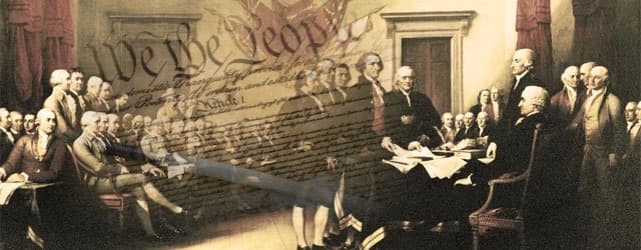
As you know, I am not a Christian. In fact, I have never been to a single Church service. I have never read the whole Bible. And yet, I think the United States of America is (or at least was) the greatest nation in the world and in history. Without reading “The Declaration of Independence” and Thomas Paine’s “Common Sense” and appreciating and loving them, I do not think that I would have become a naturalized citizen.

Buddhism, and Eastern religions in general, in their esoteric core, deal with inner freedom. Freedom or Liberty can be negatively defined as the condition of absence of compulsion (inner) and coercion (outer). Eastern spirituality made it possible for dedicated individuals to attain inner spiritual freedom, and yet no Eastern society ever achieved outer social freedom on its own.

Lao Tzu teaches the Way (道) of achieving inner freedom, but Confucian ethics and politics never have gone beyond external authority-oriented statism. That is why the Chinese have been better at creating a hyper-statist communist nation than the Russians.

Thomas Jefferson, arguably the most well-read and scholarly of the Founding Fathers, was also a radical freethinker who in his heart agreed with his friend Thomas Paine in his radicalism and revolutionary philosophy. He did not believe in the supernatural “miracle” parts of the Bible, and famously compiled the “Jefferson’s Bible” consisting of the Christ’s moral teachings. Toward the end of his life, he called himself “Epicurean” in the tradition of Lucretius whose “On the Nature of Things” he had read not only in its Latin original but also in translations in other languages he knew. In fact, the discovery of Lucretius in 1417 marked the beginning of the Scientific Revolution that later flourished.

One of my intellectual heroes, Giordano Bruno (who was more ahead in his cosmovision than his famous disciple Galileo), was profoundly influenced by Lucretius, and so was Benedict de Spinoza, whose radical theological, ethical, and political philosophy John Locke emulated and modified, along with other British and Scottish philosophers, which in turn profoundly influenced the Founders and Framers.

The “God” of the founding freethinkers and philosophers of the United States was not the traditional orthodox Christian God but the “God” of Spinoza and Bruno, which is closer in meaning and virtually synonymous with the concept of “Nature” in Natural Philosophy. In The Declaration of Independence and The Constitution of the United States, the word “God” by itself was never used, except in the former as “Nature’s God” and the “Creator” in the sense of “Nature = God” and “Creator = Creation = Creativity”.

Christianity and all other organized religions can become (and historically have become) a mental tyranny in their dogmatism and a mind-control mechanism in the form of believing and beliefs. No one religion, if given a political power, will ever allow “religious freedom” and heterodoxy. It is only a philosophy of freedom and the mentality of freethinking that is extra-, supra-, or trans-religious that can allow such freedom and heterodoxy, while recognizing the essential importance of morality and ethics at the foundation of society about which Plato, Aristotle, and Epicurus all agree.

In the history of humanity, such freethought philosophy and freethinking mentality never played such a decisive role as in the American Revolution. Although Jefferson, Paine, and many other Founders were called infidels by their religious opponents, they were not like today’s atheists, because atheism is a form of dogmatic belief system. The Founders’ and Framers’ “God” was not an object of blind belief or faith but of Reason (which they knew was fallible) and Understanding (which they knew was never complete).

“Nature’s God” can be used as the term of translating “Tao (道)” into English. The difference between the Eastern understanding and the Western understanding is that in the former the unknowability thereof as a whole is emphasized, while in the latter the inexhaustible knowability thereof by reason is emphasized. That which is eternal and infinite, Tao/Nature/Nature’s God, is never completely knowable and yet with the use of reason the possibility of knowledge is inexhaustible while the progress of knowledge is never ending.

The leaders of today and tomorrow thus need to be not only freethinkers but also original philosophers, that is, the 21st century version of the Founders and the Framers of the United States of America.

Leaving The Crowd

The collective unconscious has hacked the individual subconsciousness (the secondary consciousness), which in turn has taken over the individual consciousness (the primary consciousness). The ego (the inauthentic and soulless self) is the placeholder of the secondary consciousness within the primary consciousness.

Since as such the ego is the collective unconscious placed inside the primary individual consciousness, the ego is psychologically a collectivist (a dweller of a hive mind) and ideologically prone to collectivism of one kind or another.

As the psychologist Boris Sidis first identified: “Mob-energy rises as the powers of the mass.” Whereas the masses increase in an arithmetical progression, the energies of the masses increase in a geometrical progression. That is, the masses grow as the logarithms of their energies. Ergo, if M is the mass of the mob, then M = Log E.

The more you partake of a more massive crowd, whether actually or virtually, the more the secondary sub-awake subconsciousness, and hence the more the collective unconscious, will take over your psyche and consciousness, and the more you will succumb to the dictate of the hive mind and herd energy.

Therefore, every day or night, leave the crowd, find a space and time for solitude, be alone in the universe with your primary self, and think authentically for yourself. In other words, make a habit of meditating and contemplating by yourself.

Liberty vs. Tyranny: Whose Responsibility?

1- Liberty vs. Tyranny

“The supreme mystery of tyranny, its prop and stay, is to keep men in a state of deception, and with the specious title of religion [ideology] to cloak this fear by which they must be held in check, so that they will fight for their servitude as if for salvation.” — Benedict de Spinoza, Tractatus Theologico-Politicus

Fundamentally there are only two alternative systems of government: Liberty or Tyranny.

Democracy is considered the synonym of Liberty, but it usually turns into a system of Tyranny. The Constitutional Republic that the United States is, is designed to elevate Democracy to the system of Liberty.

Tyranny takes place when a society turns against itself, with one part usurping the sovereign power of the people and applying that power to control and exploit the rest.

One common feature of Tyranny is corruption: the misdirection of public deed or good for private gain. The government of Liberty strives to rid itself of corruption, whereas the government of Tyranny must introduce corruption, because it cannot subsist without corruption.

Government through fear is another common feature of Tyranny, since it is through fear that one part of the society can effectively control the rest, by imposing its will upon the rest and inducing it to betray its own rational interests.

Yet, the unacknowledged bitter truth is that the ultimate responsibility for the existence of Tyranny lies not with the tyrants but with the people themselves. Tyranny is the people’s self-betrayal, arising from their misunderstanding and irresponsibility.

Sovereignty always belongs to the people and therefore under a tyrannical government it is the people that are tyrannizing themselves. Tyranny is people’s ultimate psychological racket or self-deception to remain the suffering victims and maintain their victim consciousness and status, collectively.

Therefore, Liberty is for the people who are self-responsible sovereign individuals that understand what it takes to be free, whereas Tyranny is for the people who are the irresponsible victim collective that fail to understand what it takes to be free and sovereign.

Today a historic war is being waged between the insurgent force of Liberty and the intransigent force of Tyranny. What is unprecedented is the reality that the leader of the insurgent force of Liberty is already in the White House, while the intransigent force of Tyranny is transnational and globalist in nature and in political orientation.

Today there is no neutral middle ground. You must choose between Liberty and Tyranny, Freedom and Enslavement, and Sovereignty and Subjugation.  

Think for yourself. Inform yourself. And be responsible not only for yourself but for the destiny of your nation and your world. Know that without the Freedom of Thought and of Information, there can be no Sovereignty, no Freedom, no Liberty.

2- Liberty and Quantum Logic

The system of Liberty is the social-political framework in which Freedom of Thought and of Action is maximally and optimally allowed. Therefore, in Liberty multiple paths of sense-making or decision-making are not only allowed but also encouraged. In Tyranny no such freedom is permitted. Both sense-making and decision-making are dictated by the political power structure that monopolizes the political, economic, military, and ideological power-source centers.

If you understand Lupasco’s quantum logic (see “The Logic Behind My Thought”) correctly, his logical framework provides for levels of reality wherein the observed horizontal duality or vectors crosses the vertical observational vector. When applied to the macro-phenomenon, Liberty constitutes the upward vector toward a greater dimensionality, complexity, and degree of freedom, while Tyranny constitutes the downward vector toward a lesser dimensionality, complexity, and degree of freedom.

We can exchange the term ‘liberty’ with ‘evolution’ and the term ‘tyranny’ with ‘devolution’. When you align your consciousness with the Evolutionary Liberty Vector, you tend to choose thoughts, ideas, and actions (sense-making and decision-making included) that are conducive to the movement of individual life and society whose vector is that of increasing freedom.

One of the great values of Lupasco’s quantum logic is its applicability to the macro phenomenal reality, though it originated in the effort to understand and explicate the quantum phenomena. It is a dynamic Logic of Liberty and Freedom in which our thought is no longer confined to one level of reality or a static duality.

When Patrick Henry said, “Give me liberty, or give me death,” on March 23, 1775, in his speech to the Second Virginia Convention, he was asserting his total commitment to the Evolutionary Liberty Vector, precisely because the downward devolutionary vectorial alternative, Tyranny, was tantamount to the descent to death.

The Founders and Framers of the United States vigorously argued and rigorously disagreed, and yet they were all aligned with one another in the Evolutionary Liberty Vector. Freedom of thought and expression thereof is essential for a dynamic evolution of society. Liberty is born out of this Freedom, while Tyranny suppresses that Freedom, while unfreedom leads to devolution.

The existence of dualism or duality, of disagreement or difference, is not the issue at all. The real issue is Freedom. The Freedom to allow duality and difference needs to be present in order for society to thrive and for people to pursue happiness, which was and is synonymous with self-realization and the virtues that make happiness or self-realization possible.

FOR DONATION:
BTC > bc1qhtkfj254w4q3uuyhdzd5qy6wupmyc7at9uez80
Copyright ©2026 Yasuhiko Genku Kimura. Web Design by Adrian Gulo